
Hair Knowledge
Hair Porosity Test for Extensions: A Buyer’s Guide
Aug
Porosity affects how a hair fiber interacts with water and treatment products, but the familiar low-, medium- and high-porosity labels are not precise enough to approve a wholesale order.
For colorists and salon buyers, a practical hair porosity test for extensions should answer a commercial question: does this sample wet, dry, absorb color and retain acceptable condition in the professional workflow planned for the SKU?
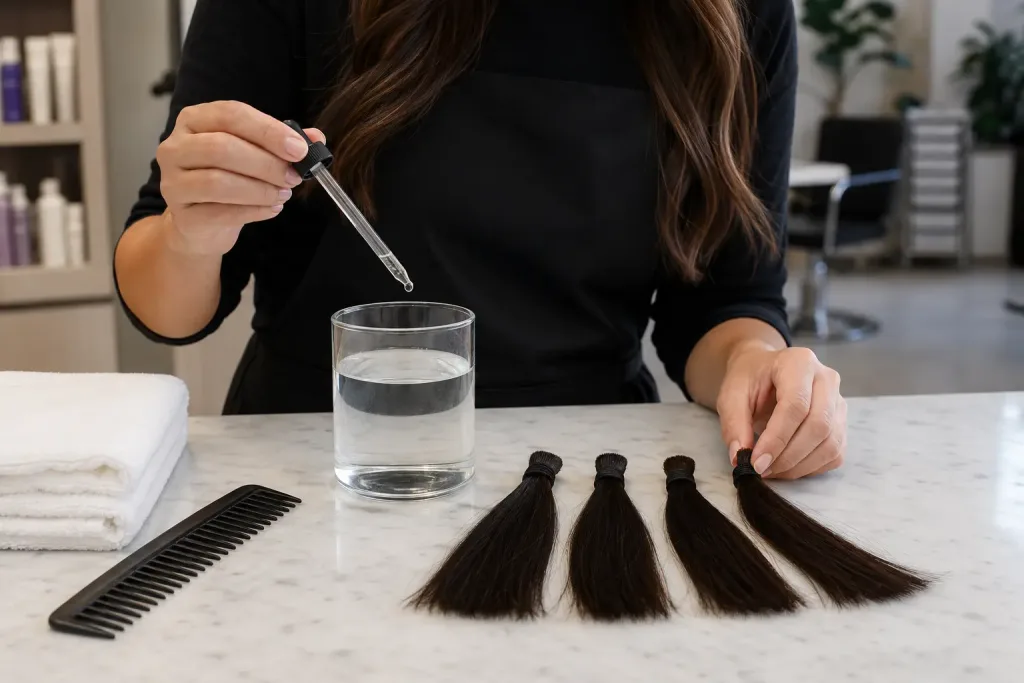
The best approach is comparative. Use coded samples, fixed conditions and a small professional strand test. Do not assume that a single hair floating or sinking in a glass provides a reliable measurement.
Menu
- Hair porosity test for extensions: the quick answer
- What hair porosity means
- Why extension porosity may vary
- Why the float test is not a reliable verdict
- A practical extension-porosity comparison
- A useful result scale for buyers
- How porosity affects salon purchasing
- Questions to ask the supplier
- Frequently asked questions
- Request samples for strand testing
- Sources
- About the author
- Related resources
- Explore wholesale hair categories
Hair porosity test for extensions: the quick answer
Use four checks:
- Visual and handling baseline under fixed lighting.
- Controlled wetting and drying comparison using equal sample weights.
- Repeated wash and comb observation to reveal uneven behavior.
- Service-specific strand test performed by a qualified colorist using the exact planned process.
These checks do not produce a laboratory pore-volume value. They help you compare samples and identify uneven, highly processed or unsuitable material before buying volume.
What hair porosity means
Porosity describes the voids and pathways that allow gases, water and other materials to interact with the hair fiber. The cuticle is the outer protective layer; chemical and physical damage can alter the surface and internal structure.
Primary research has used gas sorption to quantify hair pore volume. Other studies have shown that bleaching can increase permeability and damage the cuticle and cortex. Hair also swells when it absorbs water, and pH influences that behavior.
In a salon, you cannot reproduce those laboratory methods with a water glass. You can, however, observe consequences that matter to a service:
- speed and evenness of wetting;
- product uptake;
- drying pattern;
- color response;
- tangling and combing;
- roughness and frizz;
- loss of strength or excessive breakage.
Why extension porosity may vary
One pack or bundle can contain fibers with different histories:
- natural weathering from root to end;
- different donor or collection lots;
- previous coloring or bleaching;
- steam or heat texture processing;
- cuticle alteration;
- surface coating;
- mixed strand diameters;
- repeated salon treatment.
The ends may behave differently from the mid-lengths, while the outer layer of a bundle may differ from the inside. Test several sections, not one attractive strand.
Why the float test is not a reliable verdict
The popular float test places clean strands in water and interprets floating as low porosity and sinking as high porosity. In practice, the result can be affected by:
- trapped air;
- surface tension;
- strand shape and diameter;
- sample length;
- oil, conditioner or silicone;
- incomplete wetting;
- water chemistry;
- handling and test time.
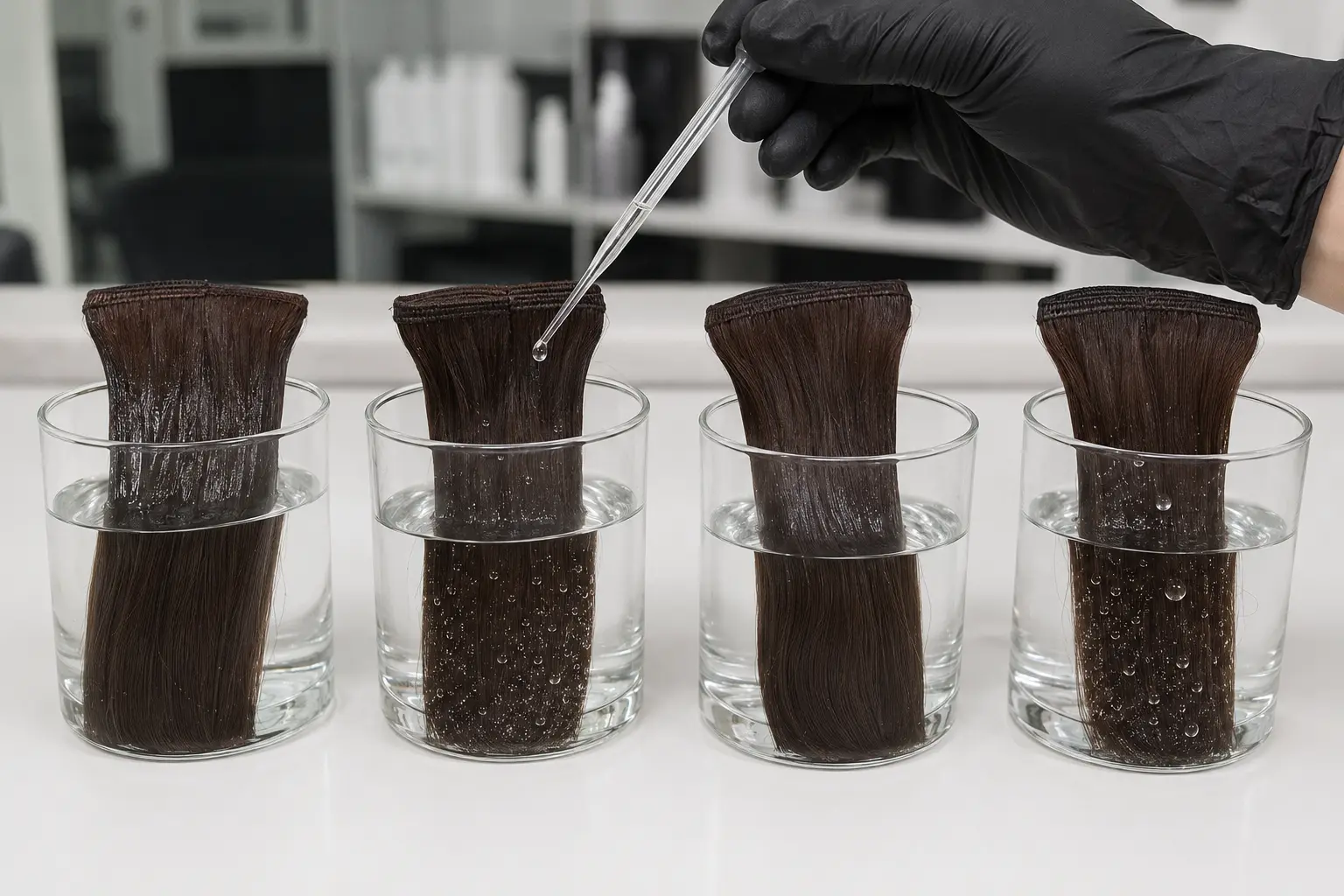
A float test may be used as an informal observation if conditions are recorded, but it should not decide whether hair is raw, Remy, color-safe or suitable for purchase. Do not turn it into a quality certificate.
A practical extension-porosity comparison
1. Build matched samples
Take equal weights from comparable parts of each bundle. If possible, include:
- an untouched control;
- a known natural-hair reference;
- a previously approved extension reference;
- the new supplier sample.
Code them so the evaluator does not know which supplier or price tier is being tested.
2. Record the dry baseline
Under neutral lighting, record:
- color and undertone;
- shine;
- surface feel;
- texture;
- top, middle and end condition;
- dry combing effort;
- released fibers;
- visible residue.
This baseline is essential because a surface finish may affect later wetting.
3. Compare wetting under fixed conditions
Use equal sample weights and the same water source, temperature, container and timing. Lower each sample in the same way without forcing one beneath the surface more than another.
Observe:
- whether water spreads evenly;
- whether some zones resist wetting;
- whether the fiber darkens uniformly;
- bubbles and trapped air;
- time until fully saturated under your method;
- changes in flexibility and tangling.
Do not assign a universal porosity number. Rank the samples relative to the approved control.
4. Wash and air-dry
Use the same mild cleanser and rinse method. Blot without rubbing and air-dry under the same airflow, position and room conditions.
Record:
- time to reach the same dry endpoint;
- uneven drying along the sample;
- texture change;
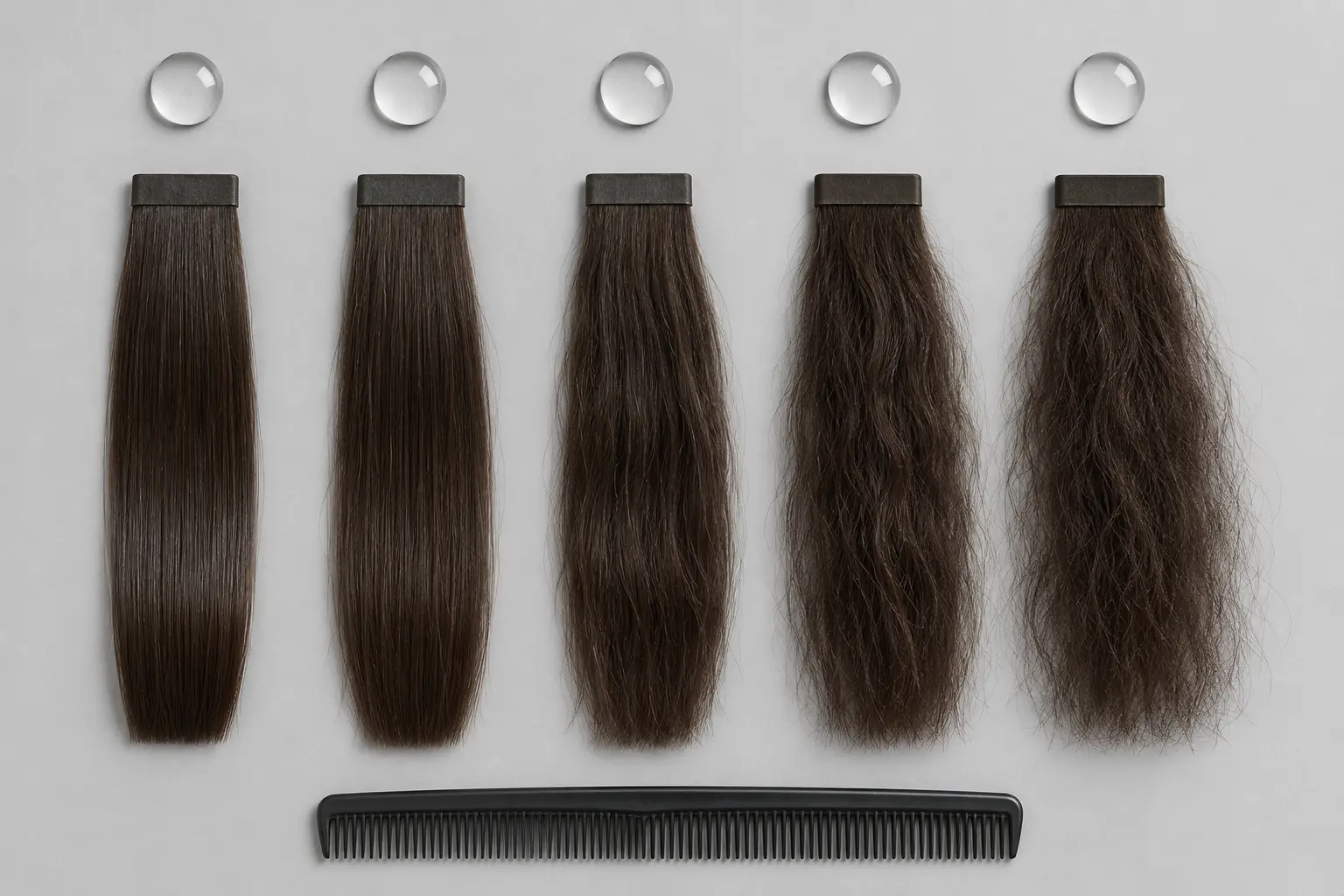
- frizz;
- roughness;
- tangling;
- end condition.
Drying time alone is not a porosity measurement. Bundle size, airflow, texture and construction also matter.
5. Repeat the comb check
Compare the same number of gentle comb passes before and after washing. Increased snagging may indicate exposed damage, uneven processing or finishing loss, but it does not identify the cause by itself.
6. Run a professional strand test
If the SKU will be colored, test a small section with the exact professional process planned for it.
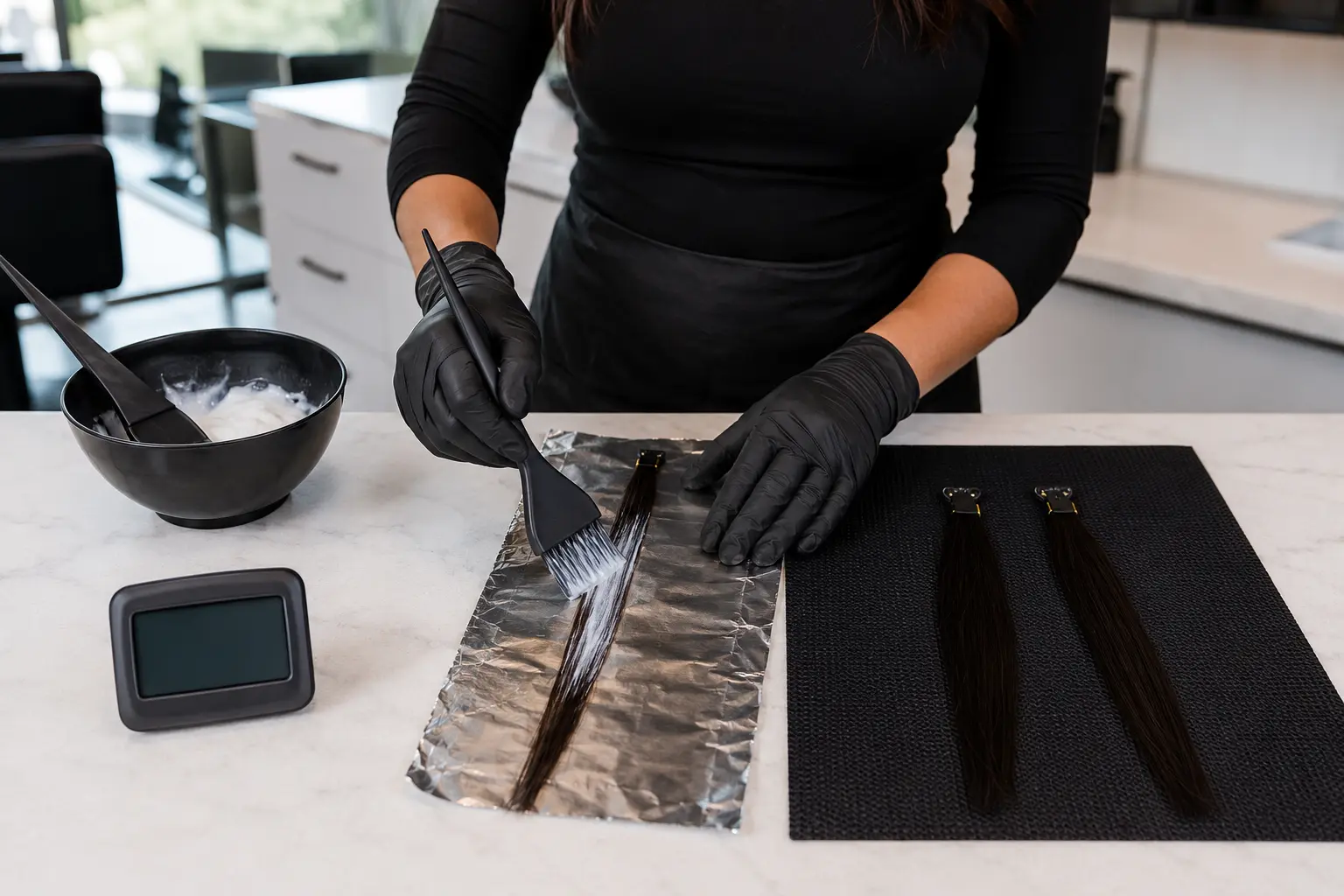
Record:
- starting color;
- formula and product batch;
- application amount;
- timing and observation intervals;
- rinse and aftercare;
- achieved level and undertone;
- evenness from top to ends;
- wet and dry condition;
- combing and breakage;
- whether the result meets the sellable shade standard.
Do not publish a universal bleach formula or promise that every production lot will lift identically. The strand test applies to that sample and that controlled process.
A useful result scale for buyers
| Result | Observable behavior | Buying implication |
|---|---|---|
| Controlled and even | Wetting, drying and color response are reasonably uniform | Suitable to continue evaluation |
| Slightly absorbent | Faster or stronger uptake but manageable condition | May suit some coloring, with tighter process control |
| Uneven | Different zones or fibers respond differently | Higher risk of patchy color and inconsistent client results |
| Highly reactive | Rapid uptake, roughness, weakness or strong condition loss | Pause or restrict the intended service |
| Surface-resistant | Slow or uneven wetting, possible finish or low uptake | Investigate coating and processing; do not force a diagnosis |
The goal is not to find “maximum porosity.” Excessive reactivity can reduce control and increase damage risk.
How porosity affects salon purchasing
For custom coloring
Colorists need predictable, even response and enough structural margin for the planned shade. An extension that absorbs quickly but becomes weak is not commercially superior.
For natural-color retail
Even if the hair will not be colored, uneven porosity may affect washing, frizz, shine and aftercare. Run repeat-cycle testing.
For bulk hair and custom manufacturing
Loose bulk hair may be used for ventilation, braiding or tip production. Test the material before investing labor in a finished product.
For pre-bonded and tape products
Test the fiber and attachment separately. Water, conditioner and chemical processing near an adhesive or bond can create a construction problem even when the fiber itself is acceptable. Review Anvi Hair’s hair extensions range for format context.
Questions to ask the supplier
- What color, bleach, acid, texture, steam or heat processes have been used?
- Is any coating or finishing product applied?
- Is the sample representative of production?
- Is the hair intended for further coloring?
- What natural variation should the buyer expect?
- Can the supplier provide samples from more than one production lot?
- What post-color or post-wash tolerance is agreed?
- What happens if the order responds differently from the approved sample?
Use Anvi Hair’s wholesale buyer guide to place porosity and strand testing within a complete purchasing process.
Frequently asked questions
Can you test extension porosity with water?
Water can support a comparative wetting test, but it does not provide a complete or standardized porosity measurement. Use matched samples, controls and service-specific testing.
Does sinking hair mean high porosity?
Not reliably. Trapped air, surface tension, residue, strand geometry and handling can change whether a strand floats or sinks.
Is high-porosity hair better for coloring?
Not automatically. It may take up product quickly, but it can also color unevenly, lose condition or break. Predictable response and usable final condition matter more.
Can raw hair have porous ends?
Yes. Natural weathering can make older ends behave differently from newer hair near the root. Raw is a processing claim, not a promise of identical porosity along every fiber.
Does coating make hair look low-porosity?
A surface finish can affect wetting and slip, but a salon test cannot identify every coating. Compare pre- and post-wash behavior and request disclosure.
Should I bleach-test every new batch?
Run a professional strand test when coloring is part of the intended service, and repeat it when the production lot or specification changes. Do not assume one historical result applies forever.
Request samples for strand testing
To compare Vietnamese hair for a coloring or extension service, contact Anvi Hair with the starting product, target result, format, length, texture, test quantity and destination.
Request a sample identified to the quotation. Record your test and retain an approved control before placing a larger order.
Sources
- Anvi Hair, Wholesale Bulk Hair
- Anvi Hair, Vietnamese Hair Extensions Wholesale: The Ultimate Buyer Guide
- Wortmann et al., True porosity measurement of hair
- Malinauskyte et al., Effect of equilibrium pH on the structure and properties of bleached hair fibers
- Imai, The influence of hair bleach on the ultrastructure of human hair
- Grosvenor et al., The physical and chemical disruption of human hair after bleaching

Explore wholesale hair categories
