
Hair Knowledge
Single vs Double vs Super Double Drawn Hair
Aug
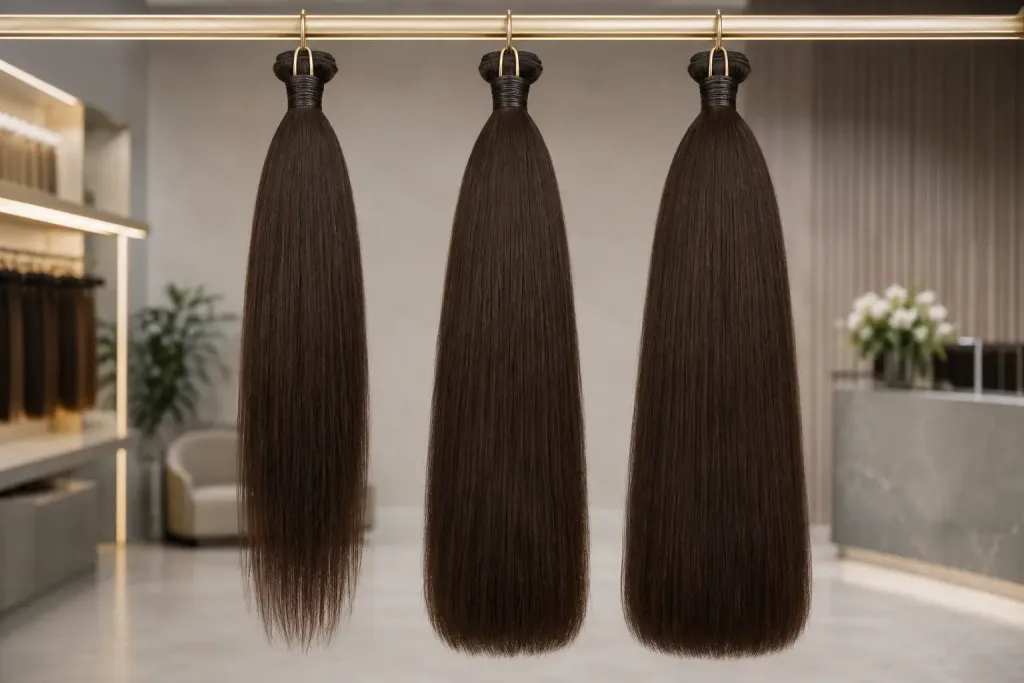
The difference between single drawn vs double drawn hair is not whether the fibers are human, raw, virgin or Remy. Drawn level describes how strand lengths are distributed inside a bundle—and therefore how full the hair looks toward the ends.
For a salon or distributor, this affects more than appearance. It changes usable weight, trimming, number of bundles, finished style, inventory tier and the price a customer will accept.
“Super double drawn” can indicate an even fuller end profile, but there is no universal percentage used by every supplier. Buyers should approve a physical profile and measurement method instead of relying on the name alone.
Menu
- Single vs double vs super double drawn: the quick answer
- What drawn level does—and does not—tell you
- Why percentages can be misleading
- What buyers actually receive at each level
- A better way to compare end fullness
- Salon decision matrix
- How drawn level affects wholesale inventory
- Common buying mistakes
- Product-format considerations
- Questions to send the supplier
- Frequently asked questions
- Request drawn-level samples
- Sources
- About the author
- Related resources
- Explore wholesale hair categories
Single vs double vs super double drawn: the quick answer
- Single drawn hair retains more mixed strand lengths, producing a natural taper.
- Double drawn hair is more heavily sorted so a greater share of fibers reaches near the stated length, creating fuller ends.
- Super double drawn hair is a supplier-defined premium fullness tier with an even denser tip profile.
| Feature | Single drawn | Double drawn | Super double drawn |
|---|---|---|---|
| Length distribution | More short and medium fibers remain | More fibers are close to the target length | Highest concentration near the target length within the supplier’s system |
| End appearance | Naturally tapered | Full | Very full or blunt |
| Styling effect | Layered, lighter movement | Balanced premium volume | Dense, dramatic volume |
| Trimming need | May need more trimming for a blunt finish | Less trimming for fullness | Minimal trimming when the approved profile is delivered |
| Inventory position | Entry or natural-look tier | Core premium tier | Top premium tier |
| Main buying risk | Ends look too thin for the target customer | Supplier’s “double drawn” may not match the buyer’s reference | Paying for a name without measurable extra usable fullness |
What drawn level does—and does not—tell you
Drawn level tells you about strand-length distribution. It does not prove:
- country of origin;
- donor count;
- Remy alignment;
- raw or virgin status;
- chemical history;
- cuticle condition;
- weight accuracy;
- lifespan;
- colorability.
A full-ended bundle can still be processed or poorly aligned. A naturally tapered bundle can still be high-quality hair. Keep each quality claim separate in the purchase specification.
Why percentages can be misleading
Suppliers sometimes advertise a specific percentage of full-length strands. The number is not useful unless the parties agree on:
- what counts as “full length”;
- the tolerance below the stated length;
- whether measurement follows the natural texture or stretched length;
- whether the sample is weighed or strands are counted;
- whether short return hairs near a weft are excluded;
- the sampling location and sample size;
- whether production is measured the same way.
One factory’s double drawn may resemble another factory’s super double drawn. A retained physical sample and a fullness profile provide a clearer approval standard.
What buyers actually receive at each level
Single drawn hair
Single drawn hair keeps a broader mixture of long, medium and shorter fibers. The bundle is usually fuller near the top and gradually narrows toward the ends.
This can be desirable when:
- the client wants a natural taper;
- the natural hair is fine or layered;
- the stylist will create a feathered finish;
- the market is price sensitive;
- very dense ends would look heavy.
The commercial downside is that less of the nominal unit weight reaches the bottom zone. A buyer may need more bundles or more trimming to create a blunt result.
Double drawn hair
Double drawn hair undergoes additional length sorting. More fibers reach close to the target length, so the bottom half appears fuller and the finished style needs less corrective trimming.
This is often a practical core tier for salons because it balances:
- premium fullness;
- styling flexibility;
- inventory cost;
- client familiarity;
- usable weight.
The label still needs an approved reference. Do not assume every double-drawn sample has the same end density.
Super double drawn hair
Super double drawn usually describes the supplier’s fullest premium tier. The ends can look dense, uniform and close to blunt.
It can suit:
- high-volume luxury installs;
- polished bone-straight looks;
- premium wigs;
- clients who want strong bottom density;
- retail displays where end fullness is a major selling point.
It may be unnecessary for clients who prefer soft taper, have fine natural hair or need a lighter installation. More fullness is not automatically a better client match.
A better way to compare end fullness
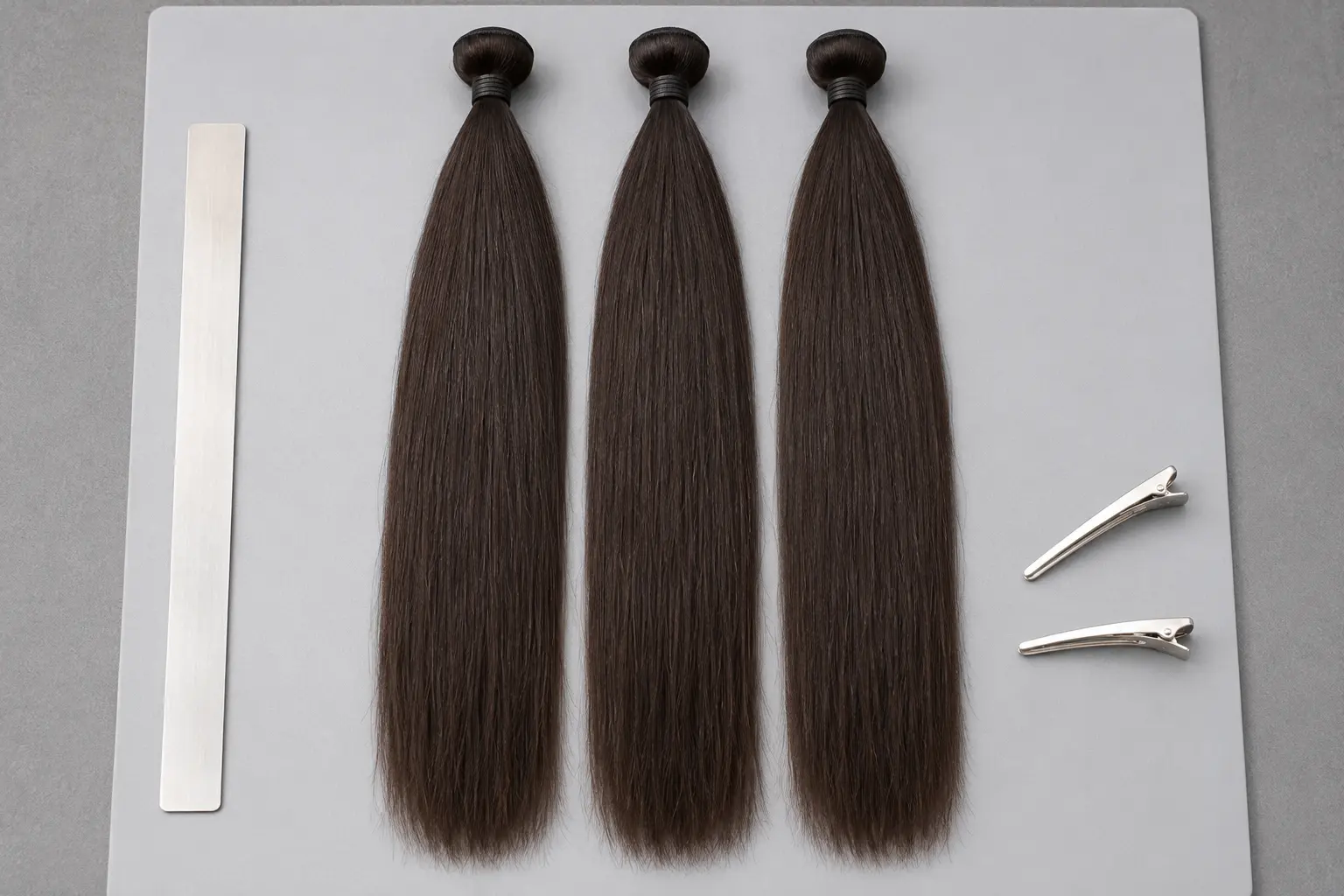
1. Standardize the samples
Compare units with the same:
- product format;
- stated length;
- texture;
- color;
- dry condition;
- total weight;
- top attachment or weft construction.
Do not compare a 100-gram straight bundle with a heavier curly bundle and attribute the visual difference to drawn level.
2. Photograph a side profile
Hang or lay each sample in the same position with consistent lighting, distance and background. Do not fan one bundle wider than another.
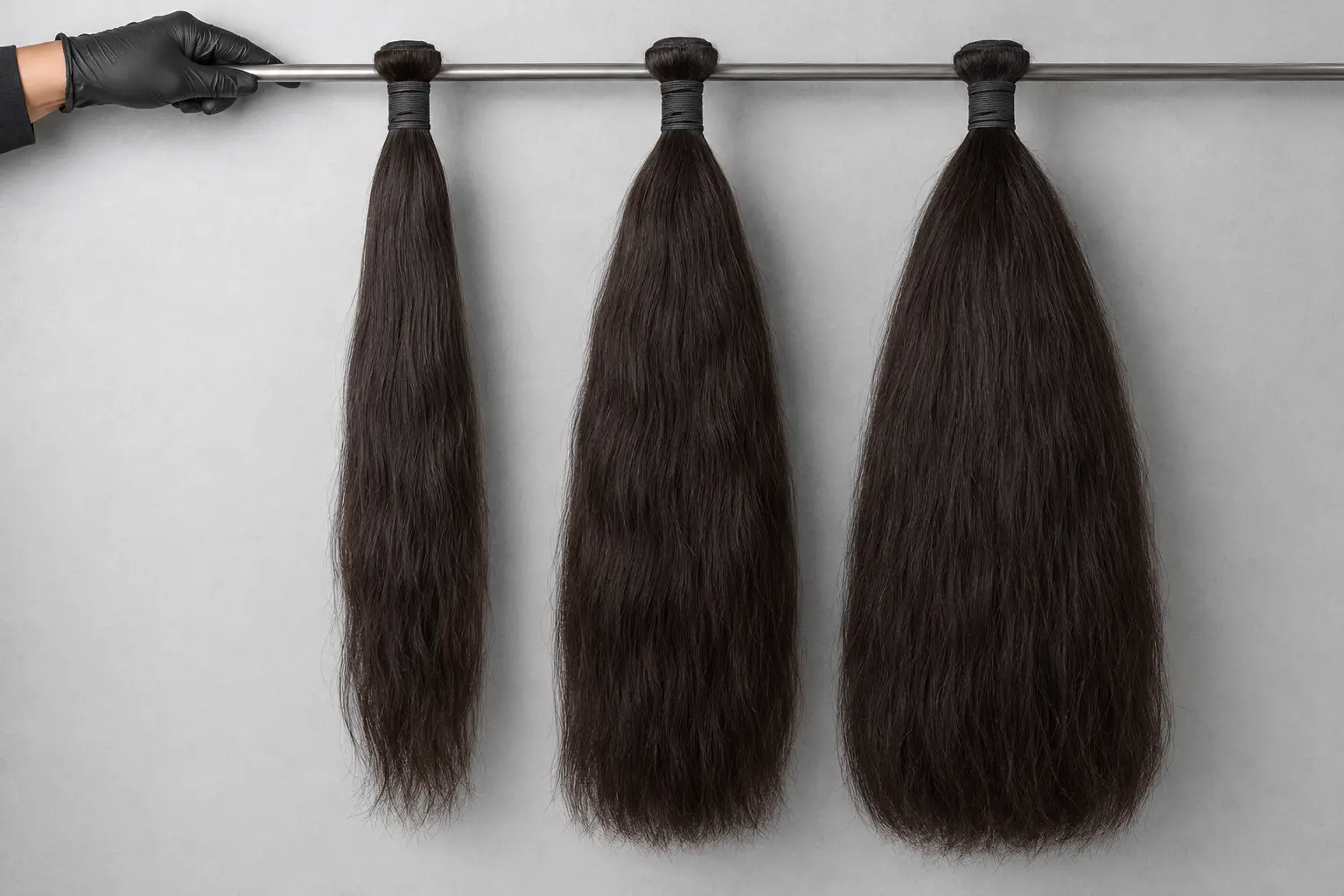
Capture:
- top density;
- mid-length density;
- bottom-quarter density;
- tip shape;
- visible gaps;
- natural texture after washing.
3. Mark measurement zones
Divide the stated length into practical zones, such as:
- top;
- midpoint;
- lower quarter;
- final tip zone.
Measure bundle width or mass in the same defined section using a documented in-house method. The exact method can be simple; consistency matters more than a marketing percentage.
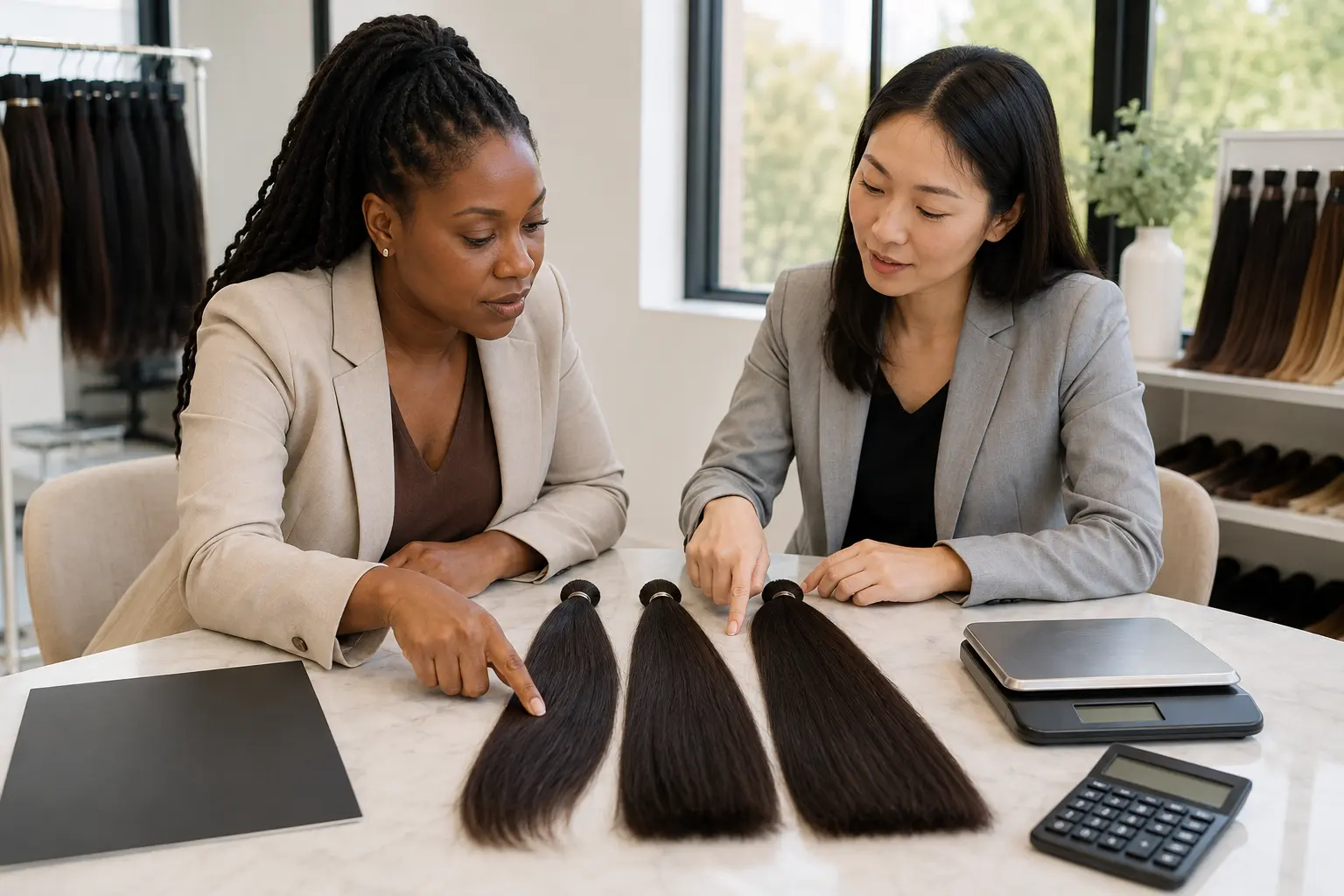
4. Compare usable yield
Ask what remains after creating the intended finish. A cheaper tapered bundle may require additional units or trimming. A fuller bundle may reduce that waste, but the price premium must still make sense.
Calculate:
usable fullness for target style ÷ landed cost
The numerator can be an internal score based on retained weight, bottom density and labor. Keep the scoring rules visible so buying decisions are repeatable.
5. Wash before final approval
Dry styling and packaging can change the apparent profile. Wash a representative sample, allow the natural or declared texture to return and compare it again when fully dry.
Fullness should remain within the agreed visual and measured tolerance.
Salon decision matrix
| Client or business need | Recommended starting tier | Reason to verify |
|---|---|---|
| Natural taper and soft layers | Single drawn | Check that the ends are not too sparse for the stated length |
| Versatile premium salon stock | Double drawn | Confirm consistent lower-quarter density across units |
| Blunt, luxury or high-volume look | Super double drawn | Confirm the extra fullness is measurable and worth the premium |
| Fine natural hair | Single or lighter double drawn | Avoid an installation that is visually or physically too heavy |
| Custom wig with dense ends | Double or super double drawn | Match density to cap, ventilation plan and target style |
| Long lengths | Approved fuller tier | Longer products can show taper more clearly; compare usable yield |
| Price-sensitive retail | Single drawn or defined entry tier | Describe the natural taper honestly |
This matrix is a starting point. Final selection depends on attachment method, head size, natural-hair density, stylist technique and client goal.
How drawn level affects wholesale inventory
Build clear price tiers
Use names that customers can understand, but connect every tier to real samples:
- Natural Taper;
- Full Ends;
- Maximum Fullness.
You may still use single, double and super double drawn in the specification. The plain-language description reduces disputes.
Separate length and fullness
Do not let a long-length SKU automatically imply premium fullness. Record:
- length;
- total unit weight;
- drawn level;
- lower-quarter profile;
- color;
- texture;
- construction.
Keep a reference by SKU
Retain the approved sample for every important combination. A 16-inch double-drawn sample may not represent a 30-inch double-drawn product.
Inspect random units on receipt
Compare several units from different cartons or pack positions. Record weight, length and end profile before products are installed or distributed.
Anvi Hair’s wholesale buyer guide provides the broader framework for ordering and supplier evaluation.
Common buying mistakes
Buying the highest tier for every client
Maximum fullness can look unnatural or feel too heavy for some clients. Stock for actual service demand.
Comparing only the top of the bundle
Most bundles look dense near the attachment. Drawn-level differences appear toward the lower half and ends.
Comparing different weights
A heavier bundle will usually look fuller. Standardize weight before judging the drawn claim.
Ignoring natural texture
Curly and wavy hair occupies more visual space than straight hair. Compare samples in the same texture and post-wash condition.
Treating drawn level as a grade for everything
Fullness does not certify processing, alignment, origin or durability.
Accepting a percentage without a method
Ask how the supplier measured it and reproduce a practical version during incoming QC.
Product-format considerations
Weft hair
Drawn level is highly visible in sewn bundles. Compare weft construction separately from fiber fullness. Buyers can review Anvi Hair’s weave hair collection for product formats.
Bulk hair
For tip making, wig ventilation or braiding, drawn level affects usable long fibers and finished density. Review bulk hair and specify whether the weight is measured before or after any custom sorting.
Keratin, I-tip and tape products
Check the complete pack, not one strand. The number of pieces, grams per piece and length distribution all contribute to installed fullness.
Questions to send the supplier
- How do you define single, double and super double drawn?
- What length tolerance counts as a near-full-length fiber?
- How is length measured for straight, wavy and curly textures?
- What is the unit weight and tolerance?
- Can you provide side-profile photographs under fixed conditions?
- Will production match the approved retained sample?
- How is the drawn level checked during production?
- What is the resolution process if end fullness is outside tolerance?
Frequently asked questions
Is double drawn hair higher quality than single drawn hair?
It has fuller ends, but that does not prove better origin, alignment or processing. It is a different length distribution and price tier.
Is super double drawn a universal standard?
No. Suppliers may define the term differently. Approve the physical end profile, weight and measurement method.
Does double drawn hair weigh more?
Not necessarily. Two bundles can have the same total weight, while the double-drawn bundle places more of that weight toward the ends.
Will single drawn hair look thin?
It has a natural taper. Whether it looks too thin depends on length, unit weight, texture, number of bundles and the target style.
Which drawn level is best for wigs?
Double or super double drawn can support dense ends, while single drawn can create a natural layered look. Match the tier to cap construction, ventilation and design.
How should a salon verify drawn level?
Compare equal-weight, same-length, same-texture samples; photograph the side profile; assess defined zones; wash the sample; and retain the approved reference.
Request drawn-level samples
To compare fullness tiers for your market, contact Anvi Hair with the product format, length, texture, color, unit weight, target end profile, quantity and destination.
Request matched samples of the relevant tiers. Your approved physical profile and written tolerance should become part of the wholesale order.
Sources
- Anvi Hair, Vietnamese Hair Extensions Wholesale: The Ultimate Buyer Guide
- Anvi Hair, Weave Hair
- Anvi Hair, Bulk Hair
- Anvi Hair, Vietnam Hair Extensions

Explore wholesale hair categories
