
Hair Knowledge
Single-Donor vs Multi-Donor Hair: Buyer Checklist
Jul
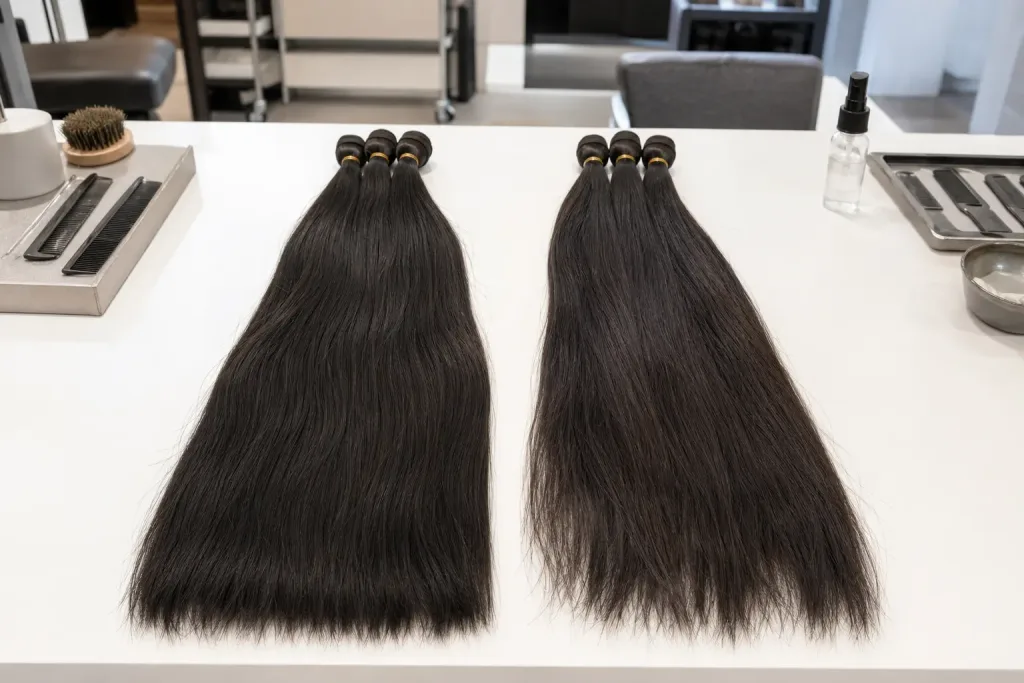
“Single donor” can sound like a complete quality guarantee. For a wholesale buyer, it is only one sourcing claim. It does not tell you whether the hair is Remy, chemically processed, coated, accurately measured or consistent with the next order.
The useful comparison is not simply single donor vs multiple donor hair. It is whether the material, sorting process and production batch deliver the color, texture, strand direction and performance your salon or brand has specified.
This guide shows how to evaluate both options, what evidence to request and how to approve a sample without turning a marketing term into a promise you cannot verify.
Menu
- Single donor vs multiple donor hair: the quick answer
- What does “single-donor hair” actually specify?
- Why one donor can still show variation
- What makes multi-donor hair good or bad?
- Single donor, Remy, raw and drawn level are separate claims
- Three types of consistency a salon buyer should measure
- A practical sample test for donor consistency
- Buyer checklist: evidence to request
- Which option should your business buy?
- Frequently asked questions
- Request a documented sample
- Sources
- About the author
- Related resources
- Explore wholesale hair categories
Single donor vs multiple donor hair: the quick answer
Single-donor hair is claimed to come from one person within the defined bundle, ponytail or lot. It can preserve a naturally coherent color, strand diameter and texture, but natural variation can still exist along one person’s hair.
Multi-donor hair combines hair from more than one person. When it is carefully sorted by color, texture, length, diameter and strand direction, it can produce a controlled commercial specification. When blending is poorly controlled, variation may appear after washing or across repeat orders.
Neither label proves quality by itself.
| Buyer question | Single-donor hair | Multi-donor hair |
|---|---|---|
| Sourcing claim | Hair comes from one person within the defined unit | Hair from two or more people is combined |
| Potential advantage | Natural coherence within the original collection | Greater ability to build repeatable volume and standardized SKUs |
| Natural variation | Still possible from roots to ends and within one ponytail | Depends on the quality of sorting and blending |
| Main risk | Paying a premium for an unsupported claim | Mixing incompatible colors, textures or strand directions |
| Best evidence | Traceable lot information plus a retained physical sample | Written sorting rules, batch records and a retained physical sample |
| Best approval method | Specification and controlled wash test | Specification and controlled wash test |
What does “single-donor hair” actually specify?
A usable purchase order should define the unit to which the claim applies. Does “single donor” mean:
- each small ponytail;
- each 100-gram bundle;
- all hair used in one weft;
- all units with the same batch code; or
- an entire production order?
Those meanings are not interchangeable. If hair from separate ponytails is combined during length sorting, coloring, wefting or order assembly, the final product may no longer match the buyer’s assumed definition.
Ask the supplier to state the claim in plain language. For example:
Each finished bundle is produced from one collected ponytail and is not blended with hair from another donor.
That statement is clearer than “100% one donor,” but it still needs to sit beside the rest of the specification: processing history, strand direction, drawn level, length method, weight tolerance, texture and color range.
Why one donor can still show variation
Hair is a biological fiber exposed to different conditions along its length. The ends are older than the hair near the root and may have experienced more sunlight, friction, washing or styling. One ponytail may include:
- slightly different strand diameters;
- naturally lighter ends;
- more weathering at longer lengths;
- a mix of straighter and more curved fibers;
- short regrowth hairs;
- different proportions of full-length strands.
Therefore, a single-donor bundle is not automatically one perfectly uniform shade or texture. Genuine natural variation may support a raw-hair product story, but it must also fit the client’s expectation.
For a salon that promises an exact repeated color, controlled multi-donor sorting may be commercially easier than accepting a naturally variable single-donor lot.
What makes multi-donor hair good or bad?
The word “mixed” often carries a negative meaning, but the decisive issue is how the hair is selected and assembled.
A controlled multi-donor batch can be sorted for:
- compatible natural color and undertone;
- similar strand diameter;
- similar natural texture;
- consistent root-to-tip direction;
- agreed length distribution;
- comparable processing history;
- similar response after washing and air-drying.
A poorly controlled batch may combine hair that only looks similar under factory lighting. After washing, one portion may become wavier, drier, lighter or more difficult to comb than another.
This is why buyers should approve performance, not only the dry appearance inside a package.
Single donor, Remy, raw and drawn level are separate claims
These terms answer different questions:
- Single donor describes the claimed number of people contributing hair to a defined unit.
- Remy describes consistent root-to-tip strand orientation.
- Raw describes a claimed low level of chemical or texture alteration.
- Virgin commonly refers to the absence of major chemical coloring or permanent texture treatment, although supplier definitions vary.
- Single, double or super double drawn describes the distribution of strand lengths and fullness toward the ends.
A single-donor ponytail can lose directional alignment if it is handled incorrectly. Multi-donor hair can remain Remy if each collection is kept root aligned and blended carefully. A single-donor bundle can be colored; a multi-donor bundle can be uncolored. A double-drawn product may come from one donor or several.
Put every claim in a separate specification field. This prevents one premium-sounding word from being used as evidence for several unrelated qualities.
Three types of consistency a salon buyer should measure
1. Consistency within one bundle
Inspect the top, mid-lengths and ends. Look for unexpected bands of color, abrupt diameter changes, hidden short fibers, mixed texture zones or sections that behave differently during gentle combing.
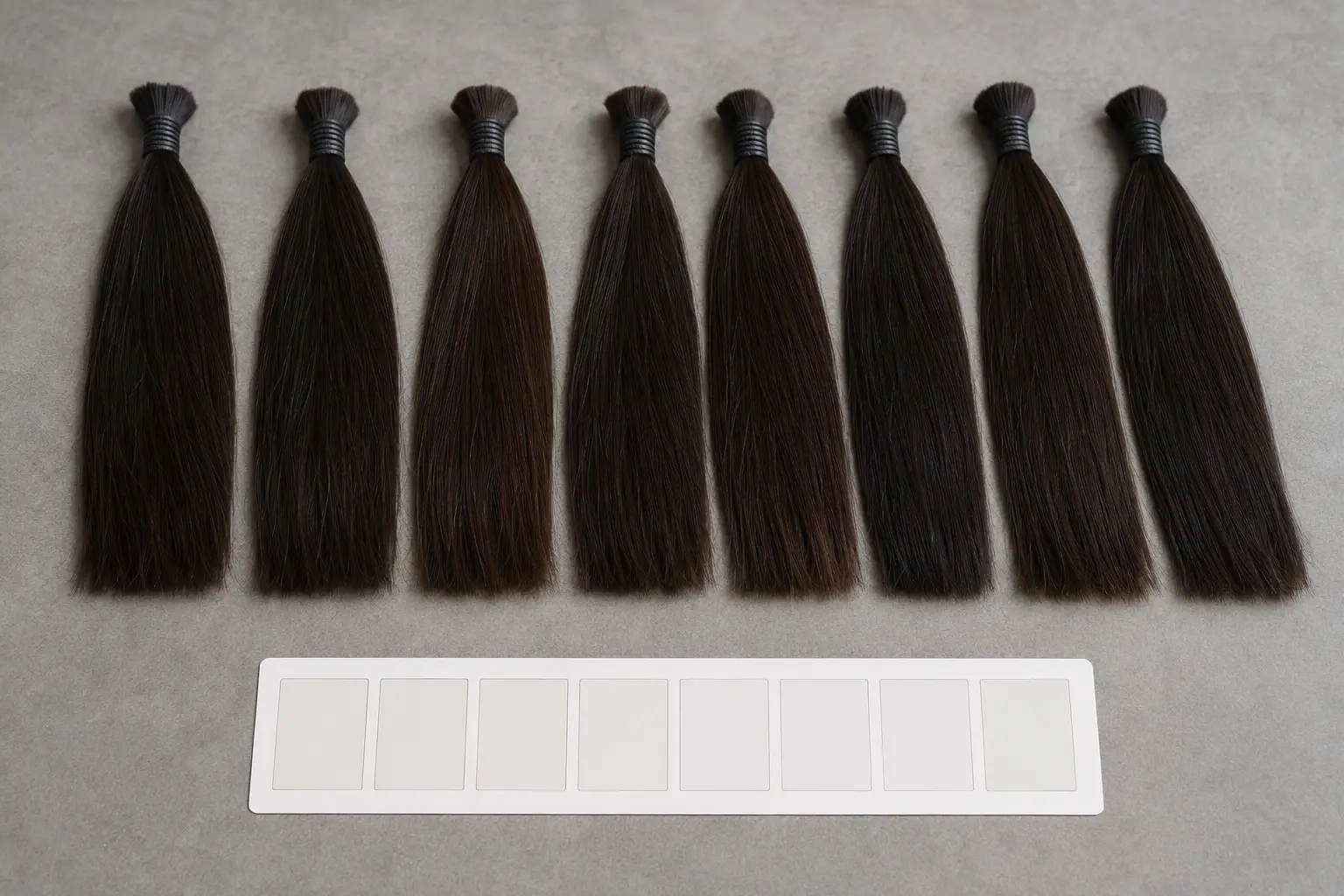
Use neutral daylight or controlled high-color-rendering lighting. Phone cameras and warm salon lights can conceal undertone differences, so retain a physical approved sample.
2. Consistency within one batch
Do not approve a wholesale batch by opening only the most attractive unit. Randomly select several bundles from different parts of the shipment.
Compare:
- unit weight using the same method;
- measured length;
- fullness profile;
- dry texture and post-wash texture;
- color and undertone;
- shedding during a fixed combing sequence;
- odor, residue and packaging condition.
The goal is not zero natural variation. The goal is variation within the tolerance your customers can accept.
3. Consistency between repeat orders
A successful first order does not prove the next production lot will be identical. Keep:
- the approved untouched control;
- the tested sample;
- reference photographs under fixed lighting;
- the purchase specification;
- the supplier’s batch code;
- receiving-QC results.
If your business needs repeated SKUs, agree on what may vary and what must remain within tolerance.
A practical sample test for donor consistency
Step 1: blind-code the samples
Give each sample a code so the person checking it is not influenced by the premium label or price. Record the supplier’s claim separately.
Step 2: inspect and measure
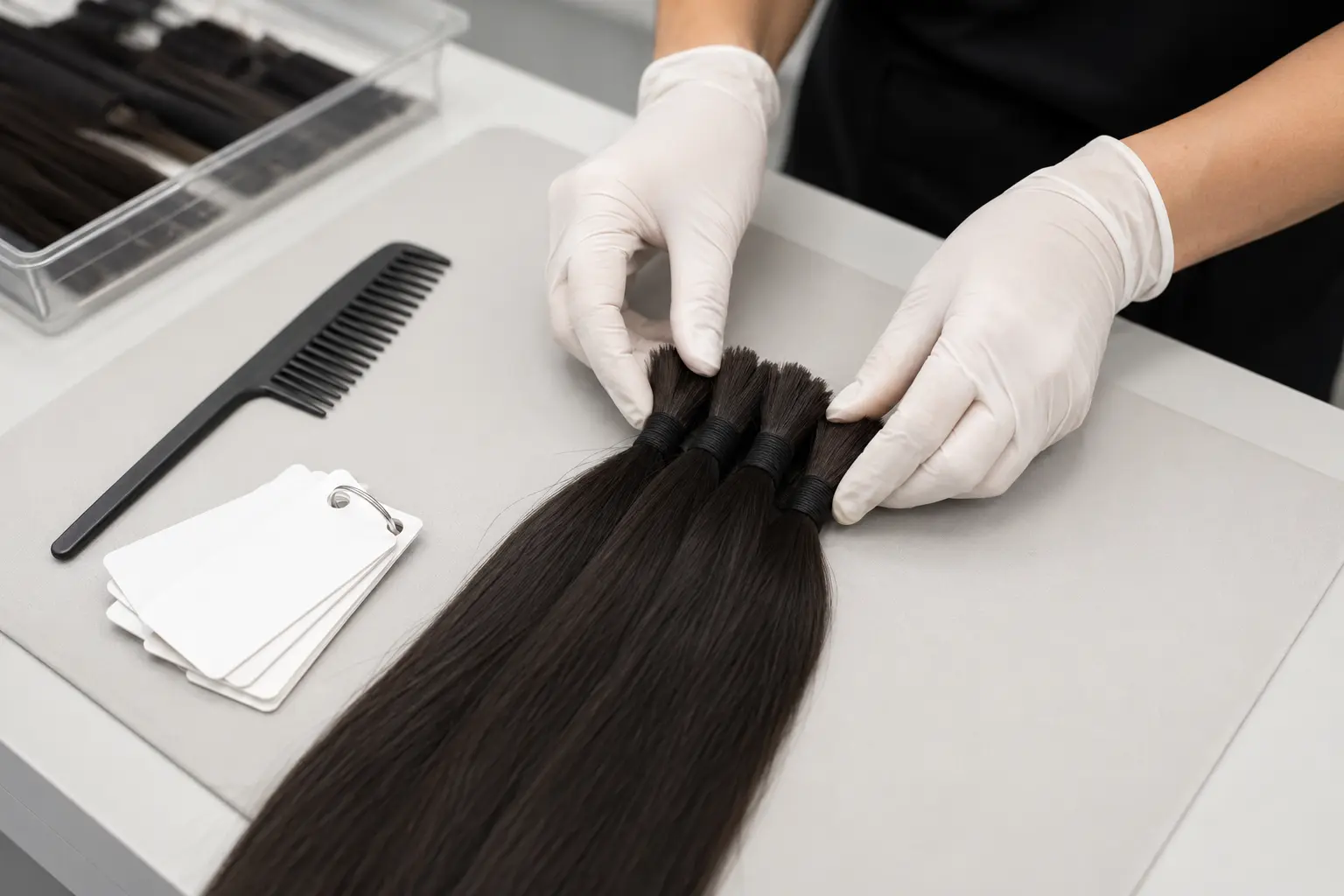
Place the sample on a neutral surface. Record weight, measured length, color range, texture, strand diameter impression and fullness from top to ends.
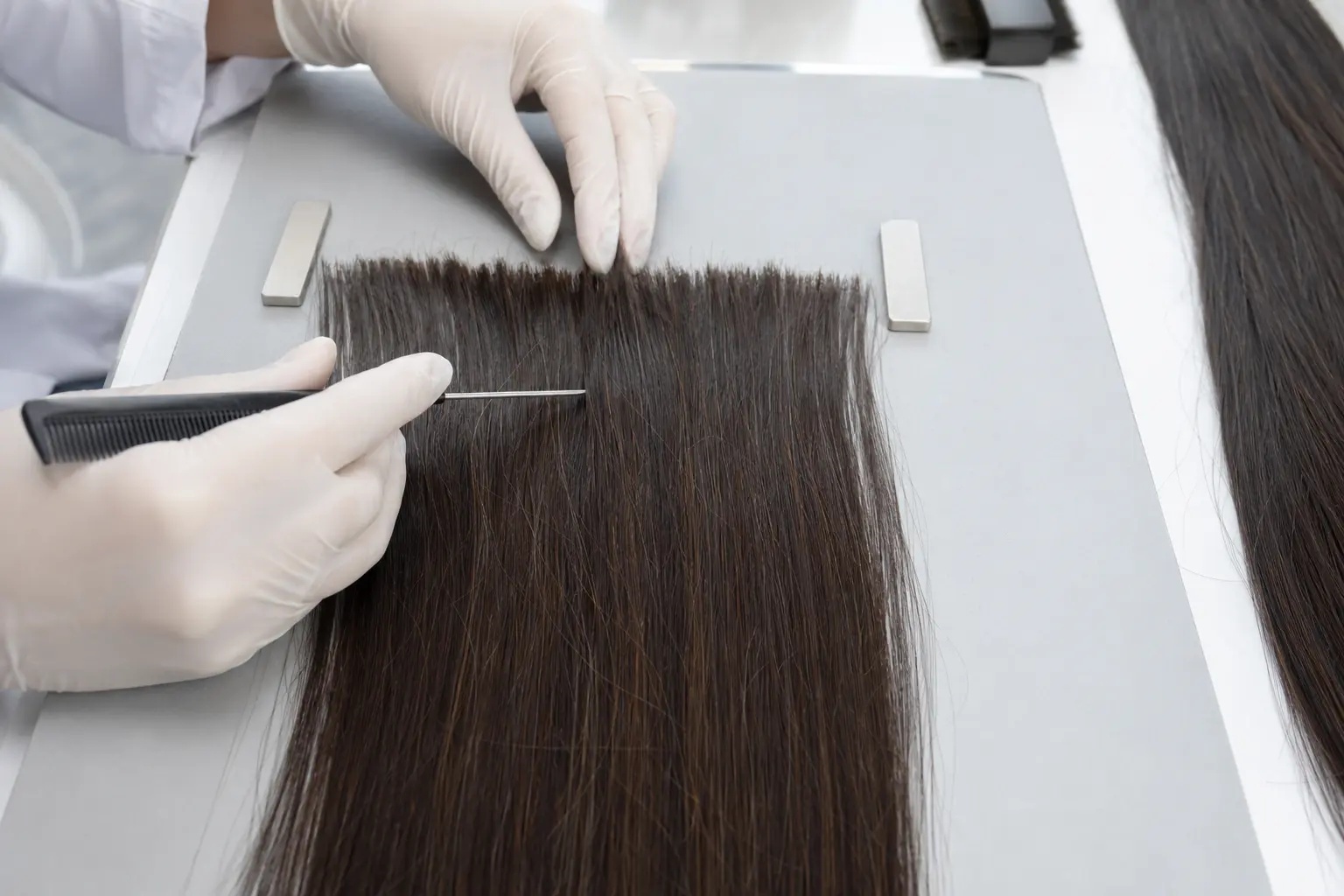
Run a gentle finger and wide-tooth-comb check in the intended direction. This cannot certify donor count, but it can reveal snagging, mixed orientation or inconsistent sections that deserve further investigation.
Step 3: wash a representative section
Keep an untouched control. Wash equal sections using the same water, product amount, technique and drying method. Do not use an aggressive “test” designed to make one sample fail.
After full air-drying, compare:
- texture recovery;
- color and undertone;
- slip and residue;
- tangling and combing effort;
- visible frizz;
- end condition;
- released fibers.
Step 4: score commercial fit
Use a simple 1–5 scale for measurable categories, but define what each score means. A sample should not receive a higher score merely because it says “single donor.”
For example, a multi-donor sample with repeatable color, correct weight and stable wash performance may be a better retail SKU than a naturally variable single-donor sample. A premium raw-hair line may make the opposite choice.
Step 5: retain the control
Seal an untouched portion and the tested section together with the completed worksheet. Use this set when production arrives.
Buyer checklist: evidence to request
| Request | What a useful answer includes |
|---|---|
| Definition of donor claim | The exact unit covered: ponytail, bundle, weft, lot or order |
| Collection and blending statement | Whether hair is combined, and at which production stage |
| Processing declaration | Color, bleaching, texture creation, acid treatment, coating, steam and heat history |
| Strand-direction statement | How root-to-tip orientation is preserved |
| Sorting standard | Color, texture, diameter, length and fullness criteria |
| Batch identification | A code connecting quotation, sample and production |
| Tolerance table | Acceptable weight, length, color, texture and fullness variation |
| Representative sample statement | Confirmation that production will follow the approved reference |
| Resolution process | Inspection period and action if the batch falls outside the agreed specification |
Anvi Hair’s broader Vietnamese hair extensions wholesale buyer guide explains product formats and supplier evaluation. Use the checklist above as the donor-consistency layer within that purchasing process.
Which option should your business buy?
Consider a single-donor specification when:
- natural variation is part of your premium product positioning;
- traceability is important to your brand story;
- the supplier can define the claim clearly;
- the sample fits your intended coloring, ventilation or extension workflow;
- you can manage smaller or variable lots.
Consider a controlled multi-donor specification when:
- you need more repeatable volume;
- standardized color, texture and diameter matter;
- the sorting process is documented;
- random units perform consistently after washing;
- the usable yield and landed value suit your market.
The correct choice is the one your team can specify, test, receive and sell honestly.
Businesses developing loose-hair products can review Anvi Hair’s bulk hair collection. For an overview of the company’s Vietnamese extension formats, see Vietnam hair extensions. Confirm current product details and availability directly before ordering.
Frequently asked questions
Is single-donor hair always raw?
No. Donor count and processing history are separate claims. Single-donor hair may still be colored, texture-processed or coated.
Is multi-donor hair always non-Remy?
No. Hair from several donors can remain directionally aligned if the collections are handled and blended correctly. Ask how root-to-tip orientation is preserved and verify sample behavior.
Can I prove donor count with a wash test?
No. A wash test can reveal differences in texture, color, residue and handling, but it cannot prove how many people contributed to the bundle.
Why can single-donor hair have different colors?
One person’s hair can show natural variation because of sun exposure, age of the ends, strand diameter and previous care. Define an acceptable color range instead of assuming perfect uniformity.
What is more important than the donor label?
For most B2B decisions: accurate processing history, strand direction, batch consistency, measurable specifications, sample performance and a written resolution process.
Should a first wholesale order use single- or multi-donor hair?
Start with the product specification that fits your market, then test a representative sample. Keep the first order limited until receiving QC confirms that production matches the approved control.
Request a documented sample
To compare donor and batch options for your salon or wholesale market, contact Anvi Hair with the product format, texture, color, length, drawn level, quantity and destination.
Ask for a written donor definition and a sample identified to the quotation. The approved sample—not the label alone—should become the reference for your order.
Sources
- Anvi Hair, Vietnamese Hair Extensions Wholesale: The Ultimate Buyer Guide
- Anvi Hair, Vietnam Hair Extensions
- O’Connor et al., Atomic force microscopy of human hair cuticles
- Weiand et al., Understanding and controlling the friction of human hair

Explore wholesale hair categories
