
Hair Knowledge
How to Choose Bulk Hair for Wig Making

Aug
The question bulk hair for wig making matters because a product choice affects much more than the look of one sample. It changes consultation, installation, inventory, client expectations, quality control and the cost of correcting a mismatch.
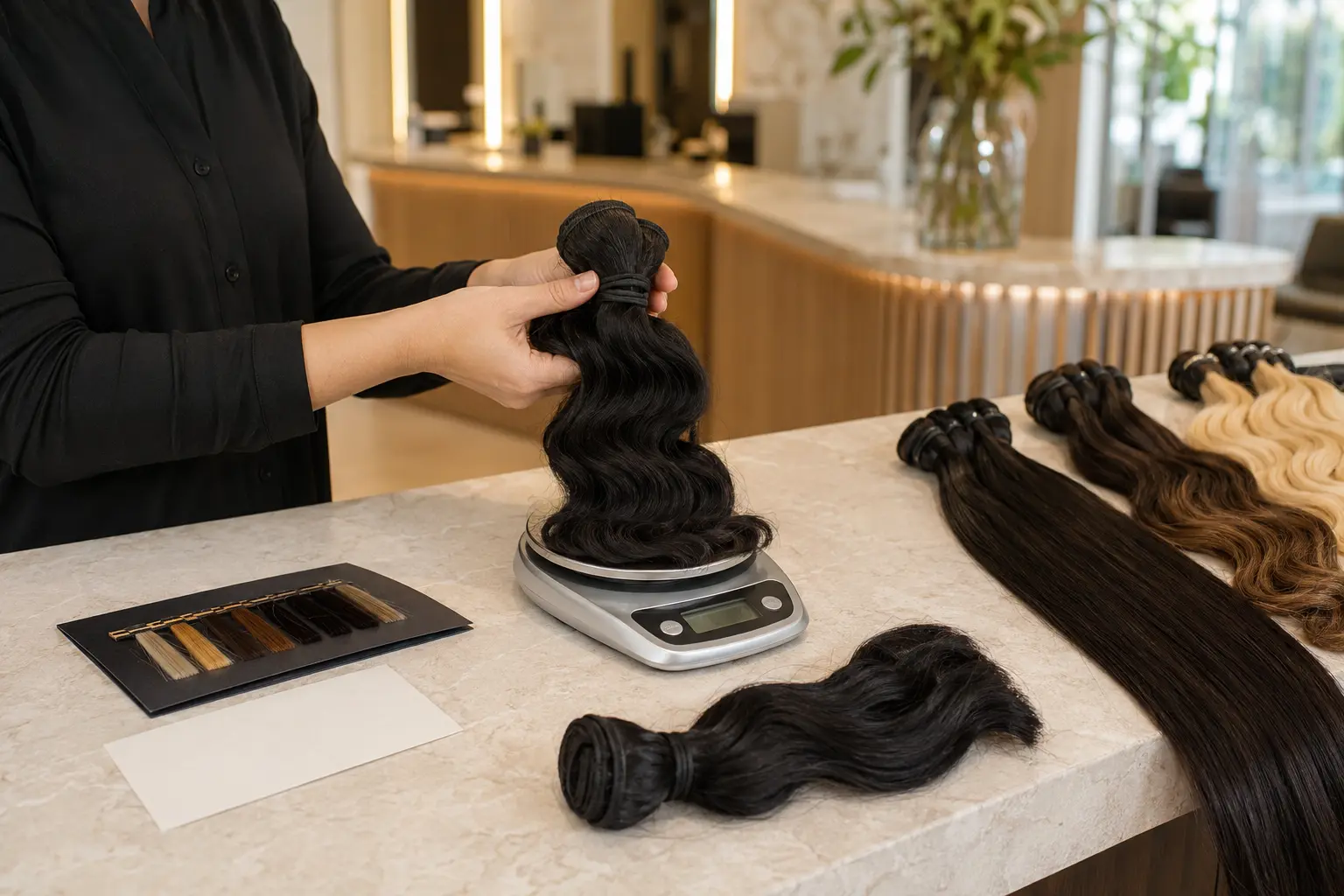
Bulk hair for wig making should be specified around the construction plan: hand ventilation or custom wefting, target density, cap size, length map, color, texture and expected waste. Approve usable yield after sorting and ventilation—not only the packaged weight.
This guide is written for professional buyers. It does not treat marketing names as universal standards, and it does not promise identical performance from every lot. Use the framework below to approve the exact product you plan to sell or install.
Menu
- Quick comparison
- What the label does not prove
- A practical evaluation framework
- Understanding every decision point
- Standardized test protocol for bulk hair for wig making
- Three real-world business scenarios
- Client consultation and order-taking script
- Risk register before a larger order
- A 30-day pilot and launch plan
- Buyer inspection checklist
- How to turn a sample into a purchase specification
- Inventory and pricing implications
- Use a three-stage pilot before scaling
- Example approval scorecard
- Hand the specification to sales and support
- Common mistakes
- Questions to ask the supplier
- Final buying recommendation
- Frequently asked questions
- Sources and further reading
- About the author
- Related resources
- Explore wholesale hair categories
Quick comparison
| Decision point | Option or condition A | Option or condition B |
|---|---|---|
| Fiber direction | Root-to-tip orientation kept clear | Reduces avoidable tangling risk |
| Drawn level | Matches density map and end profile | Controls fullness and trimming |
| Color consistency | Same-lot roots, mids and ends | Prevents patchy finished units |
| Texture | Stable after wash and ventilation | Supports repeatable production |
| Usable yield | Measured after sorting and waste | Connects purchase cost to finished wig cost |
What the label does not prove
The commercial label is only the beginning of the specification. It does not confirm origin, donor count, cuticle direction, previous chemical work, color tolerance or a fixed service life.
For a fair comparison, keep the following variables constant wherever they apply:
- product format and attachment system;
- stated length and measuring method;
- net weight or piece count;
- color and undertone;
- drawn level and lower-quarter fullness;
- washing, drying and photography conditions;
- production lot and supplier specification.
If two samples differ on several variables at once, the comparison may produce a confident answer to the wrong question.

A practical evaluation framework
1. Start with the cap and ventilation plan
A lace-front unit, full-lace wig and machine-made cap use hair differently. Define parting, perimeter, density zones and return-hair tolerance before choosing the bundle.
For wholesale approval, turn this point into a written field on the sample scorecard. Record the method, the result and the person who checked it so the production lot can be evaluated in the same way.
2. Protect root-to-tip orientation
Loose hair becomes harder to manage when roots and tips are mixed. Use labeled ties, controlled workstation flow and small working sections during ventilation.
This is also a client-expectation issue. Sales, installation and support teams should use the same description; otherwise a technically acceptable product can still create a preventable complaint.
3. Choose drawn level by design
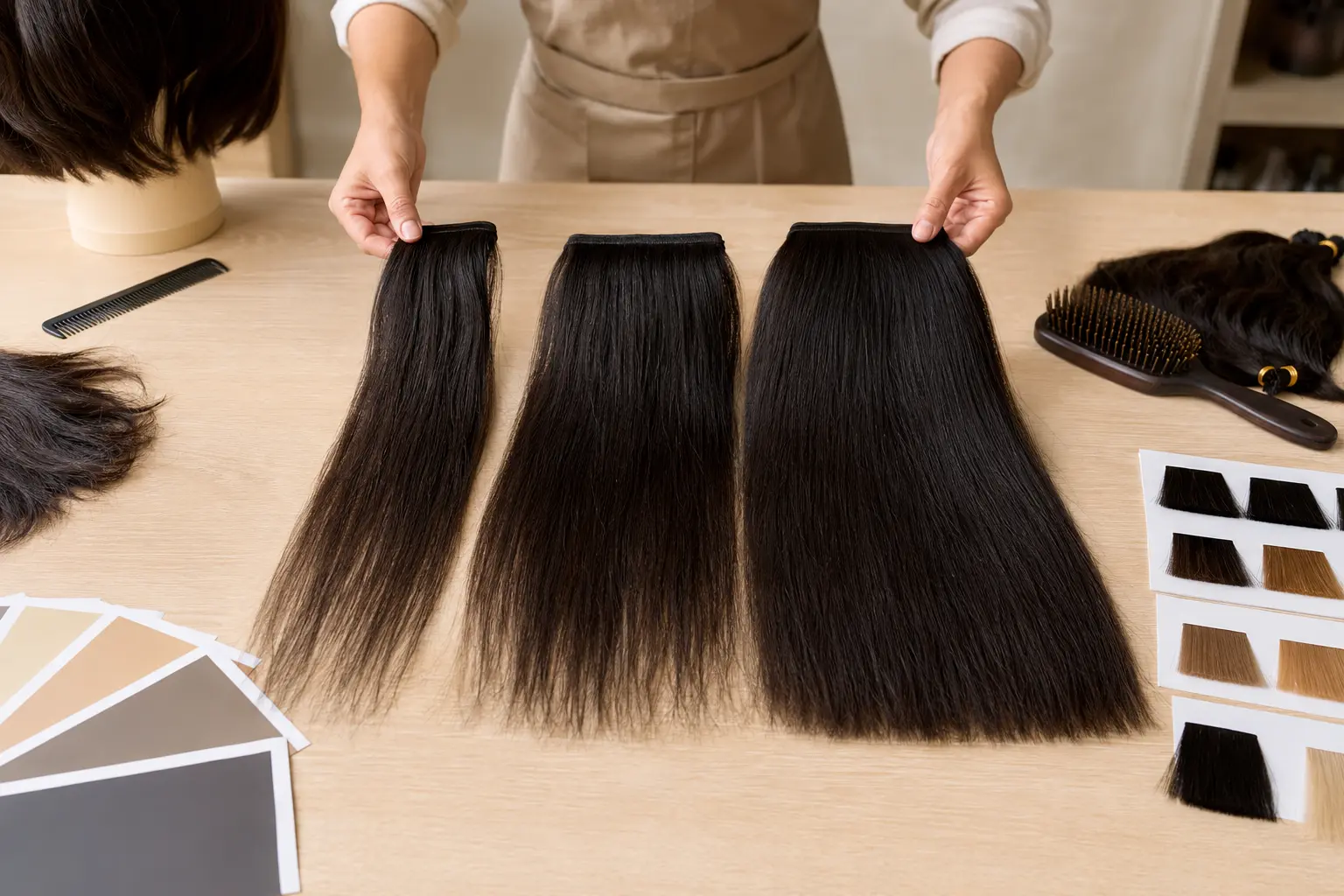
Natural layers may benefit from mixed lengths, while a blunt luxury unit needs more full-length fiber. Do not buy maximum fullness if the style will remove it during layering.
Compare at least one retained reference and one current-lot unit under the same conditions. If the difference is visible but still acceptable, document the tolerance before the order is released.
4. Measure production yield
Record packaged grams, grams accepted after sorting, grams ventilated and leftover material. Yield reveals whether a lower-priced lot is actually economical.
The commercial question is not whether the sample looks attractive for a few minutes. It is whether the result is repeatable, serviceable and appropriate for the promised price tier.
5. Approve color and texture as a set
Wash a representative sample before production. Compare the dried pattern, luster and color to the approved unit in the lighting used for product photography.
Keep this decision separate from unrelated claims such as origin, donor count or raw status. Each claim needs its own evidence and acceptance rule.
6. Write a repeatable specification
Record origin claim, processing, length method, drawn level, color, texture, grams, tolerance and packaging. Attach photos of the approved sample.
For wholesale approval, turn this point into a written field on the sample scorecard. Record the method, the result and the person who checked it so the production lot can be evaluated in the same way.
Understanding every decision point
A long-form comparison is useful only when it changes the quality of a decision. The five points below translate the headline topic into observable differences, client outcomes and purchasing controls. They should be adapted to the exact format, length, color and construction under review.
Fiber direction
Use fiber direction during staff training. Present one known example of root-to-tip orientation kept clear, one of reduces avoidable tangling risk and one borderline unit. Ask employees to classify them independently and explain what action they would take. Differences in classification reveal unclear language before they create inconsistent client advice or stock release. Agree the final action for the borderline case and add it to the reference guide. Training should cover what the characteristic does not prove as well as what it shows. This prevents employees from using one visible feature as evidence for unrelated claims about origin, processing, grade or lifespan.
Drawn level
For online wholesale selling, demonstrate drawn level without relying on display-dependent polish. Show matches density map and end profile and controls fullness and trimming in the same unfiltered frame, then add a short clip of relevant movement or handling. State the sample length, weight, color, construction and whether it has been washed or styled. A customer comparing on a phone needs this context to understand what the image can and cannot show. Save the approved media with its lot or sample reference; do not let a photograph from an exceptional old batch become the permanent promise for every future production run.
Color consistency
A repeat-order review of color consistency should begin before the old stock is exhausted. Select a clean retained reference showing same-lot roots, mids and ends and compare it with the incoming condition described as prevents patchy finished units where relevant. Complete the review while there is still time to hold, replace or correct the new lot. If the new result is intentionally different, create a revised SKU or specification instead of overwriting the old description. Version control protects repeat customers who reorder by name and expect the same service outcome. It also lets the business evaluate whether a change improved sales, margin or complaint rate.
Texture
When texture becomes a complaint, avoid jumping directly from supports repeatable production to a conclusion about product quality. Establish what the unit originally showed, whether stable after wash and ventilation was actually approved, and which service or care steps occurred. Compare evidence from receiving, installation and follow-up. A useful investigation distinguishes a specification mismatch from damage, unsuitable recommendation, technique, maintenance or normal variation. Record the conclusion and the confidence level. If the evidence is incomplete, change the process that failed to capture it. Do not create a stronger technical claim merely to close one support case quickly.
Usable yield
Set the acceptance boundary for usable yield before price negotiation. The buyer may prefer measured after sorting and waste, accept a controlled amount of connects purchase cost to finished wig cost, or require the two conditions to remain separate SKUs. Ask what production tolerance the supplier can maintain and what evidence will travel with the shipment. A specification that no supplier can repeat is not a useful standard; a loose description that accepts anything is not protection. The workable boundary sits between them and is confirmed through samples and trial lots. Once agreed, connect the boundary to payment, replacement and approval terms so the commercial documents support the technical decision.
Standardized test protocol for bulk hair for wig making
Condition all samples in the same environment and label them before any washing, styling or destructive work. The objective is not to reproduce a laboratory claim; it is to create a controlled business test that trained staff can repeat. Use professional judgment, follow product and equipment instructions, and stop a test that risks unsafe exposure or unnecessary damage.
Step 1: Construction method
Create an escalation rule for construction method. A receiver may release results comfortably inside tolerance, but a borderline result should go to the technical or purchasing owner before stock is mixed, repacked or customized. State how quickly the decision is needed and what evidence must accompany it. For a large shipment, identify whether the hold applies to one unit, one carton, one specification or the whole lot. Clear scope prevents a minor isolated issue from freezing all inventory, while also preventing widespread variation from being treated as a handful of unrelated exceptions.
Step 2: Root-to-tip control
Trend root-to-tip control over several orders instead of reading every lot in isolation. Use the same field, method and outcome codes so a spreadsheet can show changes in failure rate, correction time or visual drift. Add notes when the supplier, product process, packaging or internal reviewer changes. A gradual trend may be more commercially important than one dramatic failure, especially when each lot remains barely inside a loose tolerance. Trend data supports a fair supplier review and tells the buyer when the retained reference or product description no longer represents current production.
Step 3: Usable grams
Pair the usable grams result with a clear corrective-action category. Some deviations require replacement; some can be reworked with agreed compensation; some are acceptable only for a different SKU or price tier; others need no action beyond documentation. Do not let receiving staff invent the category while unpacking. Define it with purchasing and technical leaders, and prevent altered or downgraded units from entering the original stock code. Correct disposition protects both the client promise and inventory accuracy, which are easily damaged when exceptions are handled informally.
Step 4: Drawn level
Audit the drawn level record after the lot has been sold or used. Check whether the incoming result predicted service performance, client questions and support cases. If it did, keep the method. If it did not, determine whether the inspection condition was wrong, the sample size was too small or a later process introduced the issue. Update the next pilot rather than adding an unrelated claim. This feedback loop is what turns a checklist into quality control: the test must help the business make a better release decision, not merely create a completed form.
Step 5: Post-wash texture
For post-wash texture, preserve a concise evidence package that another person can understand without the original chat. Include the purchase-order field, unit or sample IDs, method, reference, observations, images, decision, reviewer and date. If the result is disputed, add the supplier response without deleting the original record. Keep facts separate from a proposed root cause until production or service evidence supports it. A compact, complete package speeds resolution and makes repeat-order approval more consistent, especially when the buyer, sales contact or receiving employee changes.
Step 6: Color tolerance
Define color tolerance before opening the sample. Write the equipment, conditioning time, measuring point and pass rule. Record the raw observation as well as the decision, because a later reviewer may need to understand why the unit passed. If the check is visual, include a neutral-light image beside the retained reference; if it is measured, record the unit and instrument. Repeat the check on the trial order with the same method. A supplier video can support the record, but it cannot replace a receiving result taken from the units that the buyer actually received.
Step 7: Finished-unit test
For finished-unit test, assign one owner and one controlled method. The owner should label the unit before testing, avoid mixing it with other lots and preserve any packaging that carries traceability information. Note what could distort the result, such as moisture, tension, product residue, camera exposure or an inconsistent measuring method. Test enough units to reveal variation rather than selecting only the most attractive piece. When a result falls near the limit, place the lot on hold until the buyer and supplier agree in writing whether it is acceptable, correctable or a reason to replace the affected units.
Three real-world business scenarios
Scenario 1: approving a new supplier or unfamiliar SKU
Start with a matched screening sample for bulk hair for wig making. Confirm construction method, root-to-tip control and usable grams before the team invests in more advanced work. The technical reviewer then applies the intended service to a sacrificial portion and records preparation time, usable yield and any correction. Purchasing compares the result with the written offer; sales prepares a limited description based only on what the test demonstrated. The first commercial order remains a trial lot, with a predetermined maximum quantity and a review date. Scaling is allowed only when several units reproduce the approved result and the supplier can identify the production lot.
Scenario 2: receiving a repeat order
Do not accept “same as last time” as the only specification. Place the retained reference beside units from the new delivery and verify drawn level, post-wash texture and color tolerance. Check packaging and labels before samples are separated from their cartons. If a difference is visible, estimate whether it changes the client promise, service time, sellable yield or price tier. A noncritical variation can be accepted only with a written disposition; a critical identity, construction or performance failure keeps the affected stock on hold. Update the supplier with evidence from the current lot rather than sending an unlabeled image after the products have been mixed or customized.
Scenario 3: investigating a client complaint
First identify the SKU, lot and timeline. Ask what installation, coloring, washing, heat, products, storage and maintenance occurred before the issue appeared. Compare the client unit with unused stock and the retained approval sample when available. Review the original results for fiber direction and drawn level instead of assuming that every complaint has the same cause. The resolution may involve product variance, an unsuitable recommendation, service technique, aftercare or several factors together. Preserve respectful, factual communication: document what is known, what remains uncertain and what evidence is needed before changing the supplier specification or client guidance.
Client consultation and order-taking script
The product description should help a buyer choose, not push every client toward the same SKU. Use these prompts during a salon consultation, wholesale quotation or private-label product review:
- Clarify fiber direction. Ask whether the client or business needs root-to-tip orientation kept clear or reduces avoidable tangling risk. Show the approved reference where possible, explain the maintenance or service consequence, and record the selected outcome on the consultation or order form.
- Clarify drawn level. Ask whether the client or business needs matches density map and end profile or controls fullness and trimming. Show the approved reference where possible, explain the maintenance or service consequence, and record the selected outcome on the consultation or order form.
- Clarify color consistency. Ask whether the client or business needs same-lot roots, mids and ends or prevents patchy finished units. Show the approved reference where possible, explain the maintenance or service consequence, and record the selected outcome on the consultation or order form.
- Clarify texture. Ask whether the client or business needs stable after wash and ventilation or supports repeatable production. Show the approved reference where possible, explain the maintenance or service consequence, and record the selected outcome on the consultation or order form.
- Clarify usable yield. Ask whether the client or business needs measured after sorting and waste or connects purchase cost to finished wig cost. Show the approved reference where possible, explain the maintenance or service consequence, and record the selected outcome on the consultation or order form.
Finish by confirming the exact product, quantity, length, color, texture, construction, desired result, professional service plan and maintenance responsibilities. Avoid promising a fixed lifespan or “zero” tangling, shedding, maintenance or color variation. Human hair performance depends on its condition, production, service and care, while attachment systems also depend on correct installation and client suitability.
Risk register before a larger order
| Risk behavior | Likely business consequence | Preventive control |
|---|---|---|
| Ordering by packaged weight alone | Wrong SKU recommendation, preventable return or discounting | Verify construction method; retain the result and owner |
| Mixing roots and tips | Inconsistent receiving decisions and weak supplier evidence | Verify root-to-tip control; retain the result and owner |
| Buying full ends that will be cut away | Unexpected labor, waste or reduced usable yield | Verify usable grams; retain the result and owner |
| Approving color from one photo | A client promise that the tested product cannot support | Verify drawn level; retain the result and owner |
| Starting production before sample approval | Repeat-order drift that is noticed only after stock release | Verify post-wash texture; retain the result and owner |
Review the register after the pilot order and after the first group of client services. Replace assumptions with actual rework, return, waste and sell-through data. The aim is not to eliminate every variation; it is to recognize material variation early, price it correctly and prevent a known limitation from becoming a misleading sales promise.
A 30-day pilot and launch plan
| Period | Main action | Release evidence |
|---|---|---|
| Days 1–5 | Define the intended client, service and price tier; receive and label matched samples | Offer, sample ID, package check and non-destructive observations |
| Days 6–12 | Run the controlled checks, including construction method, root-to-tip control, usable grams | Before-and-after records, method, reviewer and usable-yield notes |
| Days 13–20 | Complete a limited service or production trial with consistent care guidance | Service time, result, corrections and follow-up |
| Days 21–26 | Review cost, variation, feedback and early sell-through | Core, test or special-order decision; approved SKU description |
| Days 27–30 | Agree supplier actions and version the next-order specification | Retained reference, tolerance, owner and reorder decision |
Extend the trial when evidence is incomplete, and stop it when a critical specification or safety condition fails.
Buyer inspection checklist
| Step | Check | Evidence to retain |
|---|---|---|
| 1 | Construction method | Record the method, result, lot and reviewer |
| 2 | Root-to-tip control | Record the method, result, lot and reviewer |
| 3 | Usable grams | Record the method, result, lot and reviewer |
| 4 | Drawn level | Record the method, result, lot and reviewer |
| 5 | Post-wash texture | Record the method, result, lot and reviewer |
| 6 | Color tolerance | Record the method, result, lot and reviewer |
| 7 | Finished-unit test | Record the method, result, lot and reviewer |
Complete the checklist before cutting, coloring, installing, repackaging or mixing the unit with other lots. When destructive testing is relevant, use a separate sacrificial sample and a qualified professional.
How to turn a sample into a purchase specification
Translate the accepted sample into fields that another employee can check without guessing. Use numbers for weight and size, named methods for measurement, and reference photographs for appearance. A useful specification normally includes:
- product type and exact construction;
- claimed origin and processing description;
- length, weight or count, and the measuring method;
- texture, color and acceptable visual tolerance;
- drawn level or end-fullness reference;
- packaging, labels and lot identification;
- inspection method, acceptance rule and complaint evidence;
- approval sample identifier and date.
Avoid phrases such as “same as before” unless the earlier lot and retained sample are identified. Any substitution of fiber, construction, color or attachment should require written approval.
Inventory and pricing implications
Compare landed cost with usable yield, preparation time, likely corrections and support workload. A lower invoice price can be erased by waste or repeated service problems.
Use a simple stock structure:
- Core SKUs: combinations with repeated paid demand and dependable supply.
- Test SKUs: small quantities with a review date and a defined success measure.
- Special-order SKUs: high-variation or low-frequency items purchased after client confirmation.
Review performance by SKU and lot. Combining every product into one “hair sales” number hides which length, texture, weight, color or construction is actually producing reorders.
Use a three-stage pilot before scaling
Screening sample: verify construction method and root-to-tip control before investing time in styling or destructive tests. Reject identity or specification failures at this stage.
Service simulation: test usable grams, drawn level, post-wash texture using the actual salon or production workflow. Record time, products, tools and observations.
Trial order: inspect color tolerance and finished-unit test across several units, not only the best-looking piece. Release the SKU only after the lot matches the approved reference.
A pilot needs a pass rule before the first package is opened. Assign the reviewer, equipment, sampling quantity and storage location for evidence.
Example approval scorecard
| Criterion | Suggested weight | Approval basis |
|---|---|---|
| Construction method | 20 | Approve against the retained sample and written tolerance |
| Root-to-tip control | 15 | Approve against the retained sample and written tolerance |
| Usable grams | 15 | Approve against the retained sample and written tolerance |
| Drawn level | 15 | Approve against the retained sample and written tolerance |
| Post-wash texture | 15 | Approve against the retained sample and written tolerance |
| Color tolerance | 10 | Approve against the retained sample and written tolerance |
| Finished-unit test | 10 | Approve against the retained sample and written tolerance |
The weights below are illustrative. Change them to reflect the real failure cost of this service and make critical defects separate stop conditions.
Use three outcomes:
- Approved: the lot meets all stop conditions and reaches the buyer’s minimum score.
- Conditional hold: evidence is incomplete or a correctable issue needs written agreement.
- Rejected: a stop condition fails, the product cannot support the advertised use, or traceability is missing.
Hand the specification to sales and support
Give sales staff a short approved description covering measurement, finish, maintenance and limits. Remove absolute promises that the evidence cannot support.
Support staff should capture lot, timeline, service method, care history and clear evidence. This separates product variance from storage, processing or installation.
Common mistakes
- Ordering by packaged weight alone. It removes important context and can turn a manageable difference into a client complaint.
- Mixing roots and tips. A written method and retained reference give the team a more reliable basis for action.
- Buying full ends that will be cut away. The result may look acceptable in one photo while failing during service or repeat ordering.
- Approving color from one photo. This makes landed-cost and supplier comparisons less accurate.
- Starting production before sample approval. Separate the variable, test it consistently and record the decision before stock release.
Questions to ask the supplier
-
How should a buyer verify construction method, and what current-lot evidence can you provide?
-
What specification or limitation do you use for root-to-tip control on this SKU?
-
Can you show how usable grams is checked before packing and recorded by lot?
-
What change in drawn level would require approval before production or shipment?
-
Which sample, measurement or photo should be used to approve post-wash texture?
-
How should a buyer verify color tolerance, and what current-lot evidence can you provide?
-
Can you provide a current-lot photo or video under neutral light?
-
Will production be compared with the retained approved sample?
-
What happens if a measurable field falls outside the agreed tolerance?
-
Which changes require written buyer approval before production?
Final buying recommendation
Choose by client fit and verified production performance, then keep the approved sample as the control for repeat orders. When a claim cannot be measured directly, use retained references, controlled photography and a written tolerance instead of relying on a marketing label.
Anvi Hair buyers can compare current options in the relevant product collection, review the broader Vietnamese hair wholesale guide and contact the team with a written specification and destination.
Frequently asked questions
Can bulk hair be used for hand-tied wigs?
Yes, when the fiber and preparation suit the ventilation method.
How much hair is needed for one wig?
It varies by cap size, length, density, texture, drawn level and construction. Build a production standard from actual units.
Is double-drawn always better?
No. It creates fuller ends but may be unnecessary for layered designs.
Why is usable yield important?
Sorting, short fibers and production waste can make equal packaged weights produce different finished output.
Should the sample be washed before ventilation?
Yes for approval. It helps reveal the stable texture, coating and color behavior.
How should loose hair be stored during production?
Keep root direction labeled, protect from moisture and UV, and cover clean sections between sessions.
Sources and further reading
- https://anvihair.com/product-category/bulk-hair/
- https://pmc.ncbi.nlm.nih.gov/articles/PMC7757171/
Editorial note: Product terminology and supplier specifications can vary. Technical services, chemical processing and attachment decisions should be handled by trained professionals using the product maker’s instructions and a client-specific assessment.

Explore wholesale hair categories
