
Hair Knowledge
Remy vs Non-Remy Hair: What Salons Should Check
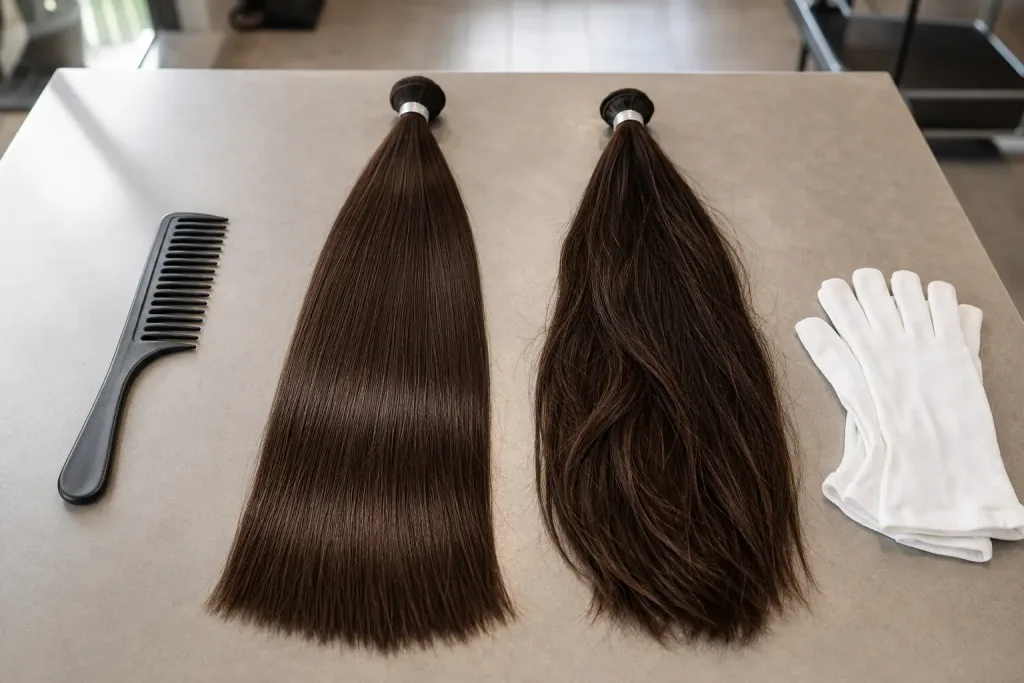
Aug
The difference between Remy vs non-Remy hair extensions often becomes visible after the sale: during washing, detangling, coloring or client wear. A bundle that feels smooth in its packaging may not retain that behavior once temporary finishing products are removed.
For a salon, the central question is not whether a supplier prints “Remy” on a label. It is whether the strands remain in a consistent root-to-tip direction, the cuticle condition is suitable for the intended service, and the production order performs like the approved sample.
This guide explains what Remy means, what non-Remy may include and how to evaluate both without relying on grade systems such as 8A, 10A or 12A.
Menu
- Remy vs non-Remy hair extensions: the quick answer
- Why strand direction matters
- Remy is not the same as raw, virgin or single donor
- Why first-touch softness is not enough
- A salon sample test for Remy hair
- How to read the results
- What salons should request from a Remy hair supplier
- Why grade labels do not solve the problem
- Remy checks by product format
- Frequently asked questions
- Request a salon test sample
- Sources
- About the author
- Related resources
- Explore wholesale hair categories
Remy vs non-Remy hair extensions: the quick answer
Remy hair is collected and processed so that the strands remain aligned in the same root-to-tip direction. The overlapping cuticle scales therefore face a consistent direction within the bundle.
Non-Remy hair may contain mixed strand directions, or it may have undergone cuticle alteration intended to reduce friction between misaligned fibers. Definitions vary across suppliers, so request a written description of the material and process.
| Buyer question | Remy hair | Non-Remy hair |
|---|---|---|
| Strand direction | Intended to remain consistently root-to-tip | May include mixed directions |
| Cuticle claim | Usually retained, although condition can vary | May be mixed, damaged, reduced or altered |
| Main advantage | More predictable handling when collection and processing are controlled | Can serve price-sensitive product tiers when accurately described and tested |
| Main risk | Unsupported “Remy” label or direction lost during production | Higher matting risk when incompatible directions and surfaces interact |
| What the label does not prove | Donor count, processing history, drawn level, lifespan or colorability | Exact treatment history, lifespan or fitness for a service |
| Best approval | Written specification plus controlled wash/comb test | Written specification plus controlled wash/comb test |
Why strand direction matters
Human hair has overlapping cuticle scales on its outer surface. Their orientation contributes to directional friction: movement toward the root encounters the protruding cuticle edges differently from movement toward the tip.
When many fibers lie in compatible directions, they tend to move together more predictably. If root-to-tip and tip-to-root strands are mixed, adjacent cuticle edges can interact in opposing directions. Combined with wear, dryness, residue or damage, this can increase snagging and matting.
That scientific principle supports the Remy concept, but it does not allow a buyer to certify a wholesale batch with one finger test. Surface coatings, conditioning and chemical alteration can temporarily change friction.
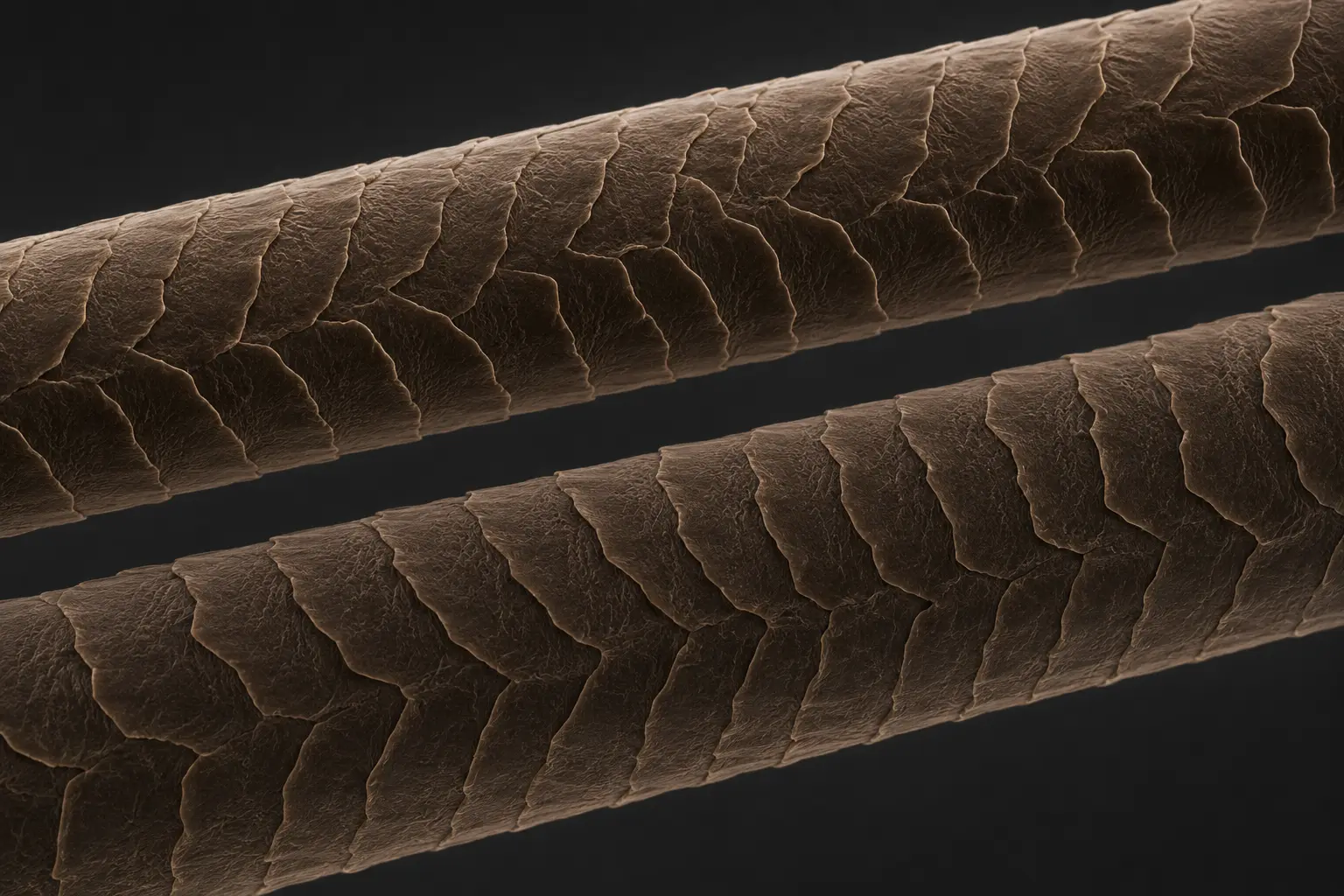
Treat cuticle direction as one part of the quality specification, not as the only measure of hair quality.
Remy is not the same as raw, virgin or single donor
Buyers frequently see these words grouped together, but each describes a different claim:
- Remy: strand orientation is maintained.
- Raw: the hair is claimed to have minimal chemical or texture alteration.
- Virgin: commonly used for hair without major chemical coloring or permanent texture treatment, although definitions vary.
- Single donor: the hair in a defined unit is claimed to come from one person.
- Double drawn: shorter fibers have been sorted to create fuller ends.
Multi-donor hair can be Remy when every collection remains directionally aligned and blending is controlled. Single-donor hair can become mixed-direction if it is mishandled. Remy hair can be colored, and raw hair can be single or multi-donor.
Require a separate written answer for each claim.
Why first-touch softness is not enough
Softness is useful, but it has several possible causes:
- healthy, aligned fibers;
- conditioning ingredients;
- silicone or other surface deposits;
- oil or finishing products;
- humidity and packaging conditions;
- reduced or altered cuticle friction.
Research using atomic-force and friction-force microscopy shows that silicone deposition can change hair’s surface friction and adhesion. Therefore, a very slippery dry sample is not proof of Remy alignment.
The relevant question is whether the hair remains manageable after a standardized wash, full air-drying and repeated handling.
A salon sample test for Remy hair
Use the same method for every supplier. Do not begin with an aggressive chemical or heat challenge.
1. Register and divide the sample
Record:
- supplier and sample code;
- quoted product and Remy claim;
- claimed origin and processing history;
- color, texture, length, weight and drawn level;
- product construction;
- intended salon service.
Keep one section untouched. Use another for wash and comb testing. If the material will be colored, keep a third small section for a professional strand test.
2. Inspect dry handling
Under neutral lighting, check the top, middle and ends. Note residue, excessive perfume, static, abrupt texture changes and short-fiber release.
Use a fixed number of slow comb passes, beginning at the ends and moving upward as you would in normal salon handling. Record:
- starting tangles;
- number of snags;
- released fibers;
- visible breakage;
- time needed to detangle.
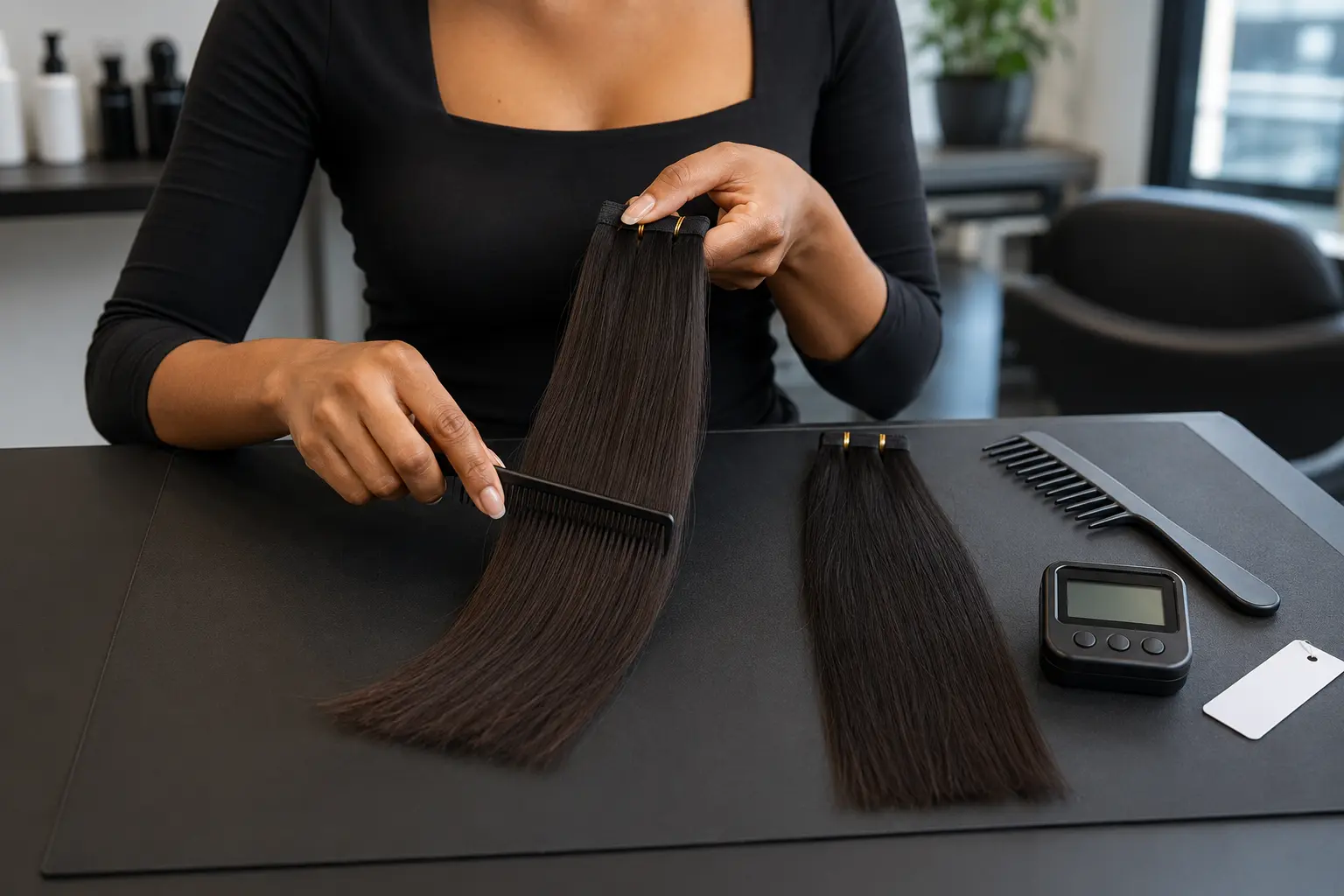
Do not pull hard enough to manufacture failure. The purpose is comparison.
3. Wash without masking the result
Wash equal sample weights using the same water, temperature range, cleanser amount and motion. Rinse consistently. Avoid a heavy mask or leave-in during the diagnostic wash unless every sample receives exactly the same treatment and that step matches your service.
Record whether:
- the water shows unusual residue;
- slip changes sharply;
- color transfers;
- fibers bunch or lock together;
- wet detangling effort increases;
- shedding differs from the dry control.
4. Air-dry completely
Half-dry hair can feel different from fully dry hair. Allow the sample to dry without rubbing or high heat. Then repeat the same comb sequence.
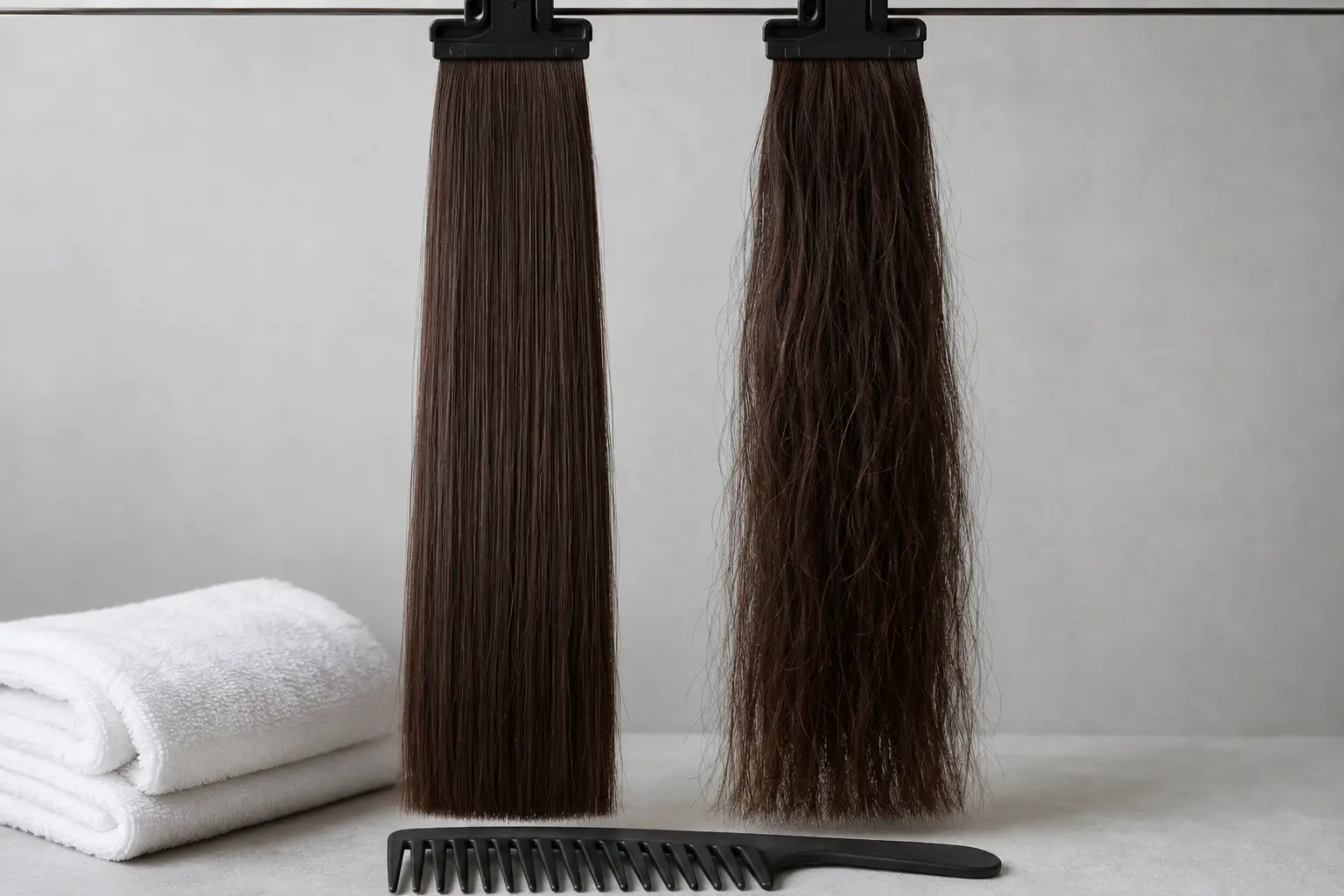
Compare the washed sample with the untouched control for:
- matting at the top or mid-lengths;
- snagging direction;
- texture consistency;
- surface feel;
- shine that disappeared after washing;
- frizz and end condition;
- comb-out and broken fibers.
A change does not automatically prove that the hair is non-Remy. It tells you the delivered finish and underlying fiber behavior require further explanation.
5. Repeat after controlled cycles
One wash may not expose a temporary finish. For an important SKU, repeat the wash-and-air-dry cycle using the same method. Document each cycle.
Approve based on the service life you need to simulate—not on a promise that one sample will last a fixed number of months.
How to read the results
| Observation | Possible explanation | Buyer action |
|---|---|---|
| Smooth dry, much rougher after wash | Surface finish removed, damage exposed or incompatible fibers | Ask for processing/finishing details and repeat with another coded sample |
| Localized matting | Mixed orientation, damaged zone, residue or mixed material | Isolate the section, photograph it and compare multiple units |
| Strong directional snagging | Cuticle orientation or surface condition may be inconsistent | Request production explanation; do not certify by touch alone |
| Stable post-wash handling | Sample meets this part of the test | Continue with service-specific and receiving QC |
| High shedding with easy combing | Construction or handling issue rather than only fiber alignment | Inspect weft, bond or attachment separately |
| Color/texture changes after wash | Processing or finishing was not fully represented dry | Compare with written specification |
No single observation identifies origin, donor count or full processing history. Build the decision from several repeatable checks.
What salons should request from a Remy hair supplier
Ask for:
- A clear definition of Remy for the quoted SKU.
- How root and tip are identified during collection.
- How direction is maintained during sorting, coloring, texturing, wefting or tipping.
- Whether cuticles are retained, reduced, acid-treated or otherwise altered.
- Any coating, silicone, oil or conditioner used before packing.
- Whether the sample is representative of production.
- Batch codes and agreed tolerances.
- The resolution process if production behaves differently from the approved sample.
If the answer is simply “highest grade Remy,” the specification is incomplete.
Why grade labels do not solve the problem
There is no universally enforced 8A–12A grading standard across all hair factories. One supplier’s 10A may describe donor claim, another’s drawn level, another’s processing or simply a price tier.
Replace the grade with measurable fields:
- fiber direction;
- processing history;
- color and undertone;
- natural or created texture;
- length measurement method;
- unit weight and tolerance;
- fullness profile;
- construction;
- sample performance;
- batch acceptance rules.
Anvi Hair’s wholesale buyer guide can help buyers place these fields within a complete supplier and ordering process.
Remy checks by product format
Weft and bundle hair
Separate fiber behavior from weft construction. Matting can relate to the hair, while shedding can relate to stitching, sealing, cutting or installation.
I-tip, K-tip and other strand-by-strand extensions
Inspect multiple finished tips from different parts of the pack. Directional alignment should remain consistent through the production of each strand. Review Anvi Hair’s I-tip extension guide for product context without using the attachment type as proof of fiber quality.
Tape-in and flat-tip extensions
Check both the hair and the attachment. Adhesive residue, tab construction or installation errors can create tangling near the roots even when the hair fiber itself meets the Remy specification.
Bulk hair
Loose hair gives manufacturers flexibility for braiding, ventilation and custom tips, but directional handling must be maintained throughout production. Secure the root end and use clear batch labels.
Salon buyers can review Anvi Hair’s hair extensions collection for available product formats. Confirm the current specification directly for every SKU.
Frequently asked questions
Is Remy hair always human hair?
“Remy” is used for human hair with aligned strand direction. Still request confirmation of fiber composition and test a representative sample rather than relying on the label.
Is non-Remy hair unusable?
Not necessarily. It may serve a lower price tier or short-term use when accurately described and when the sample meets the buyer’s expectations. It should not be sold as Remy.
Can Remy hair tangle?
Yes. Remy alignment can reduce one source of friction, but dryness, chemical damage, residue, installation, aftercare and product construction can still cause tangling.
Does Remy mean single donor?
No. Donor count and strand direction are separate. Multi-donor hair can be directionally aligned, while single-donor hair can lose alignment during handling.
Can I identify Remy hair with a burn test?
No. A burn test cannot establish strand direction, donor count, origin, processing history or future-batch quality.
How many wash cycles should a salon test?
Use a documented number that reflects your risk and service. One diagnostic wash is the minimum practical comparison, while repeat cycles provide more evidence for an important wholesale SKU.
Request a salon test sample
To evaluate Remy hair for your salon or extension brand, contact Anvi Hair with the attachment type, color, texture, length, quantity, destination and planned service.
Request a coded sample and written process details. Approve the production standard only after the sample passes your wash, comb and service-specific tests.
Sources
- Anvi Hair, Hair Extensions
- Anvi Hair, Vietnamese Hair Extensions Wholesale: The Ultimate Buyer Guide
- Weiand et al., Understanding and controlling the friction of human hair
- La Torre and Bhushan, Nanotribological effects of silicone deposition on human hair
- O’Connor et al., Atomic force microscopy of human hair cuticles

Explore wholesale hair categories
