
Hair Knowledge
How to Detect Silicone-Coated Human Hair Before Buying
Aug
Wholesale hair can feel exceptionally soft and slippery when it first leaves the package. That first impression may come from well-aligned, healthy fibers—but it can also be influenced by conditioner, oil, silicone or another finishing material applied before packing.
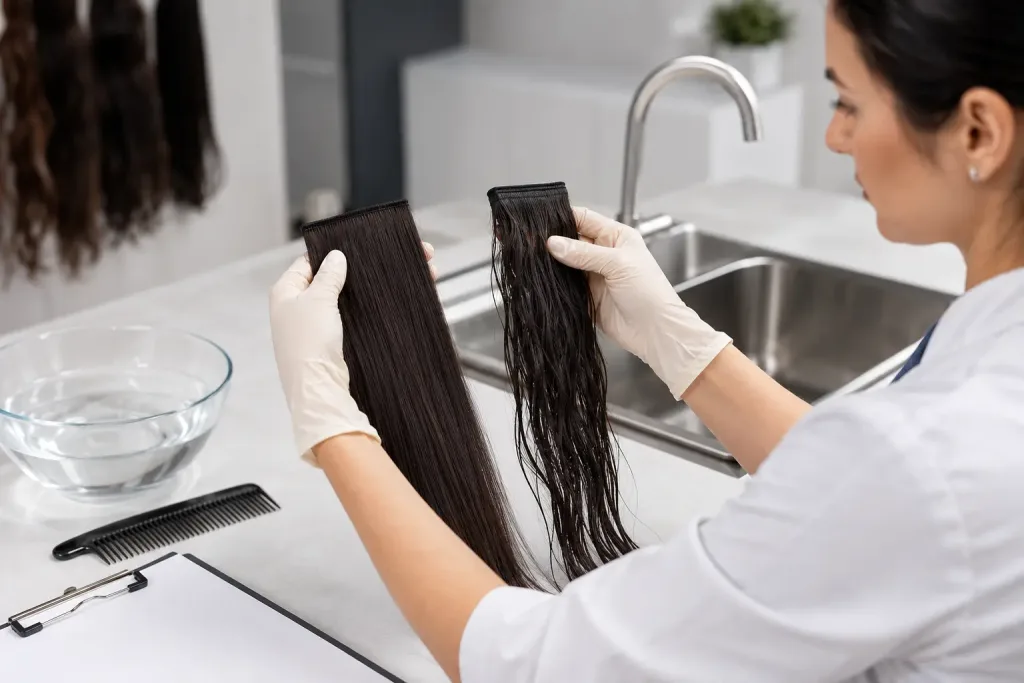
If you are researching how to detect silicone-coated hair, avoid looking for one dramatic trick. A buyer cannot identify every silicone by sight, touch or a single wash. The safer and more useful approach is to compare a coded sample before and after controlled wash, air-dry and comb cycles, then ask the supplier to disclose the finishing process.
This guide gives salons and wholesale buyers a repeatable protocol without recommending burn tests, harsh solvents or improvised chemical experiments.
Menu
- How to detect silicone-coated hair: the quick answer
- What silicone does on human hair
- Coated hair and processed hair are not the same claim
- Signs that justify further testing
- A safe wash–air-dry–comb protocol
- How to interpret the result
- Questions to ask the supplier
- Why common viral tests are unreliable
- Add coating stability to the purchase specification
- Frequently asked questions
- Request a representative hair sample
- Sources
- About the author
- Related resources
- Explore wholesale hair categories
How to detect silicone-coated hair: the quick answer
Look for a pattern of change, not one sign:
- Record the dry sample’s slip, shine, residue and combing performance.
- Keep an untouched control.
- Wash an equal measured section with a standardized method.
- Air-dry it completely without adding a masking finish.
- Repeat the same comb and handling test.
- Repeat the cycle if the SKU is commercially important.
- Compare the results with the supplier’s written declaration.
A sharp loss of slip or shine, increased snagging, exposed dryness or uneven texture may suggest that a removable finish influenced the original feel. These observations do not identify a specific silicone or prove fraud.
What silicone does on human hair
Silicones are a broad family of materials used in legitimate hair-care formulations. Depending on the chemistry and deposition level, they may improve lubrication, reduce friction, support combing or change surface feel.
Research using atomic-force and friction-force microscopy has shown that silicone type and deposition level can affect surface friction, adhesion and roughness on human hair. Other studies have examined formulation systems designed to increase silicone deposition on color-treated fibers.
Therefore, “contains silicone” is not automatically the same as “bad hair.” The commercial problem appears when a temporary finish:
- is not disclosed;
- creates a first-touch impression that does not survive normal washing;
- hides incompatible fibers or previous damage;
- causes the approved sample to differ from production;
- prevents the buyer from predicting coloring or service performance.
Coated hair and processed hair are not the same claim
A surface finish does not tell you the entire processing history. Hair may be:
- uncolored but conditioned;
- colored and uncoated;
- aligned Remy hair with a finishing product;
- mixed-direction hair treated to reduce immediate friction;
- bleached hair with a care finish;
- raw-labeled hair with an undisclosed surface treatment.
Ask about color, bleach, texture creation, acid treatment, cuticle alteration and coating separately.
Signs that justify further testing
No single sign proves silicone coating. A combination may justify a controlled retest:
- unusually glassy shine across every bundle;
- very low dry friction that disappears after washing;
- a waxy, oily or powdery residue on gloves or tissue;
- strong perfume or finishing odor;
- large difference between the surface and inner fibers;
- water beading or uneven wetting;
- post-wash roughness that was not visible before;
- tangling that increases after the first or second cycle;
- inconsistent response within one bundle.
Water beading alone is not a diagnosis. Natural surface lipids, product residue, previous processing and damage can all affect wetting.
A safe wash–air-dry–comb protocol
1. Code and document the sample
Assign a neutral sample ID. Photograph it under fixed lighting and record:
- supplier and quotation;
- product name and claimed grade;
- origin, donor, Remy and processing claims;
- color, texture, length, weight and drawn level;
- product construction;
- finishing or coating declaration;
- intended service.
Divide the material into an untouched control and a test section of known weight.
2. Establish the dry baseline
On a clean neutral surface, evaluate:
- shine under the same light angle;
- slip at the top, middle and ends;
- visible residue;
- scent;
- static;
- number of snags during fixed comb passes;
- released fibers;
- texture consistency.
Do not rub aggressively. Mechanical damage created during testing will make later comparisons less useful.
3. Run the diagnostic wash
Use the same:
- water source;
- temperature range;
- cleanser;
- product-to-hair ratio;
- wash duration;
- handling motion;
- rinse time.
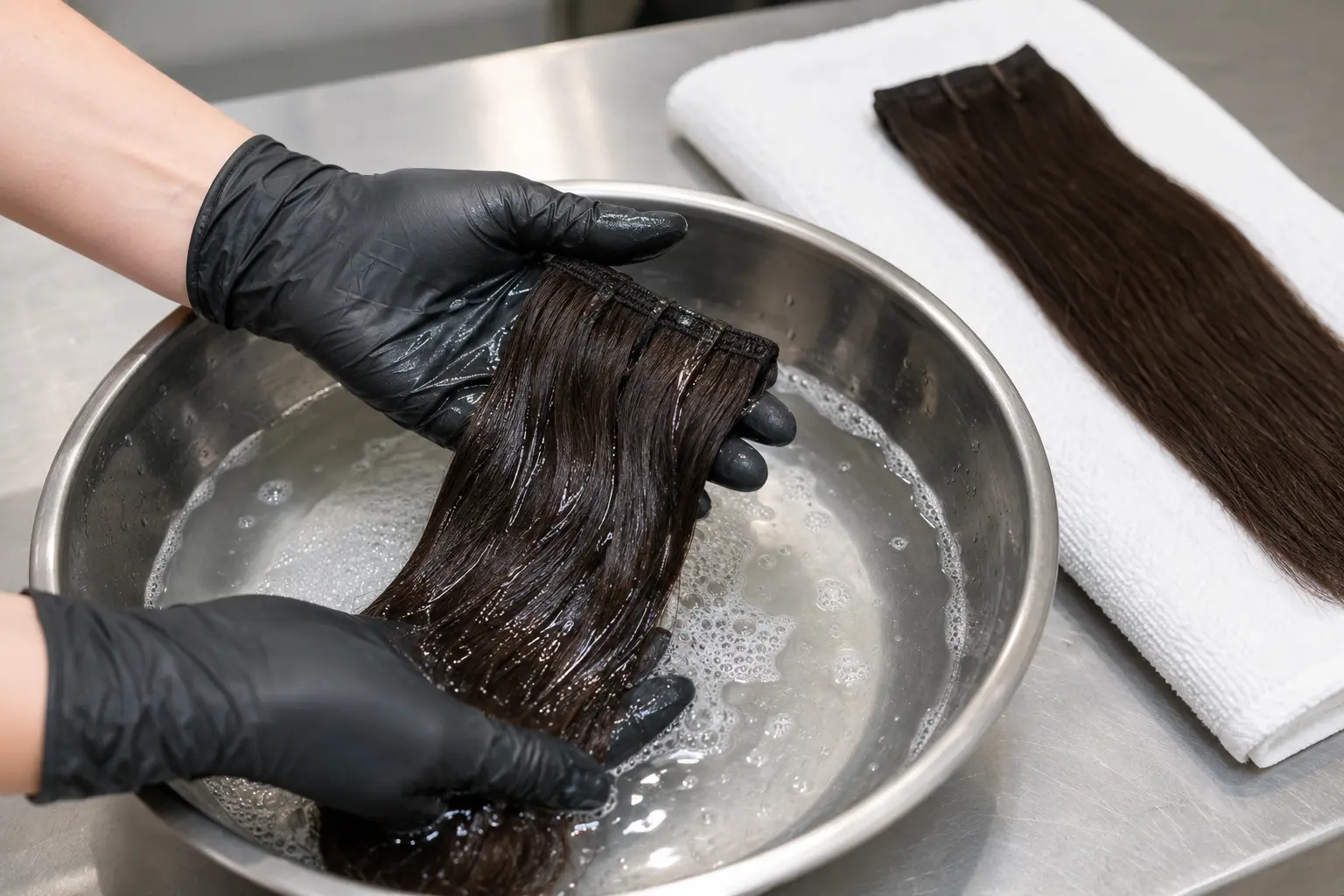
Use a mild diagnostic process that represents normal care. Do not use bleach, acetone, fuel, high-alkaline mixtures or undocumented “coating removers.” Those methods can damage the fiber, create a safety risk and produce a result that says more about the test than the sample.
Record runoff, odor change, residue, wetting pattern, wet tangling and released fibers.
4. Air-dry completely
Lay or hang the sample according to a consistent method. Do not apply serum, silicone, oil, mask or leave-in before the evaluation.
Hair may feel different when wet, damp and fully dry. Wait until the test section is completely dry before scoring.
5. Repeat the comb test
Use the same comb, starting point, number of passes and handling force.
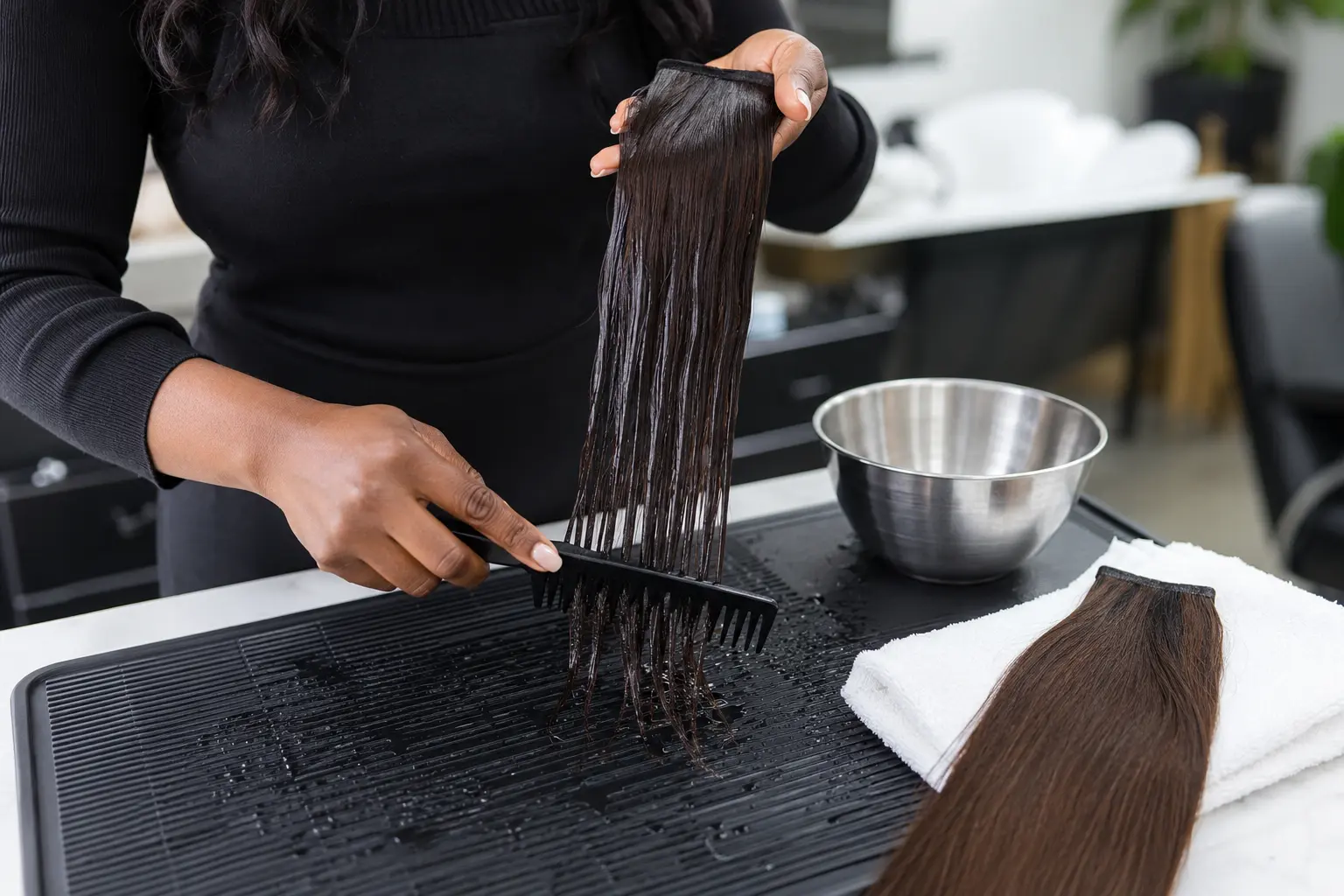
Compare:
- time to detangle;
- snag count;
- matting zones;
- slip and residue;
- shine;
- texture recovery;
- frizz;
- end condition;
- fiber release.
6. Repeat a controlled cycle
Some finishes are designed to survive more than one wash. If the product will be sold for repeated use, run another identical cycle rather than escalating to a destructive test.
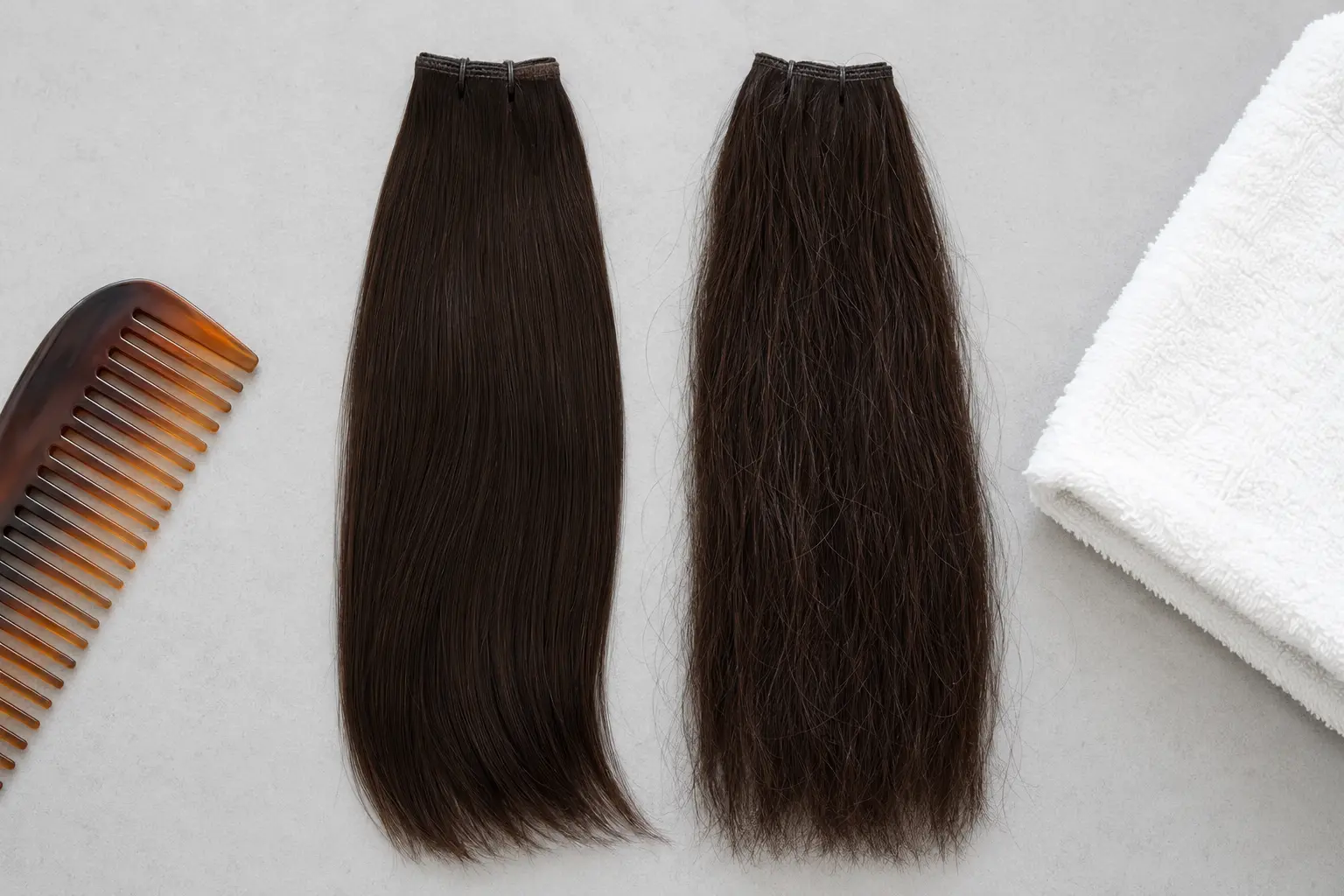
The most useful result is a trend: stable performance, gradual normal change or a sudden drop after finishing material is removed.
How to interpret the result
| Result | What it may mean | Next action |
|---|---|---|
| Slip and combing remain stable | The finish may be durable, light, absent or not central to performance | Continue service-specific testing |
| Shine decreases but handling remains good | Cosmetic finish removed without revealing a major performance issue | Decide whether the change fits the product description |
| Slip falls sharply and snagging increases | Surface finish may have masked damage or incompatible fibers | Ask for disclosure and test another coded sample |
| Only one section deteriorates | Mixed material, uneven processing or localized damage may be present | Compare multiple units from the same batch |
| Strong residue or odor leaves during washing | Substantial finishing product may have been present | Document and ask what was applied |
| Sample becomes dry after repeated cycles | Fiber condition or prior processing needs review | Evaluate usable fit; do not diagnose from feel alone |
Do not write “silicone confirmed” on a QC report unless a qualified laboratory has identified it. A salon protocol can show unstable surface-dependent performance, which is often enough to pause a wholesale decision.
Questions to ask the supplier
Send these questions before ordering:
- Is any silicone, oil, conditioner, serum, wax or antistatic finish applied?
- At what stage is it applied?
- Is it intended to remain after normal washing?
- Is the same finish used on the sample and production?
- Are the fibers acid-treated or are cuticles altered?
- What coloring, bleaching or texture process has been used?
- Can an unfinished or minimally finished sample be supplied for evaluation?
- What post-wash result is considered within specification?
The supplier may use a legitimate care finish. Accurate disclosure lets the buyer test the product as it will actually be sold.
Burn test
Burning cannot identify silicone coating, donor count, Remy direction, geographic origin or future-batch quality. It also creates fumes and a fire risk.
Flame or hot-tool smoke test
Smoke, odor or residue can come from several materials. Excessive heat can damage the sample and does not provide a controlled chemical identification.
Bleach challenge
Bleaching changes the structure and chemistry of hair. Research documents cuticle and cortex damage that increases with treatment severity. A bleach result cannot isolate a surface coating without proper controls.
Water float test
Floating or sinking is affected by trapped air, surface tension, residue, sample shape, density and wetting. It should not be used as a stand-alone coating or porosity diagnosis.
Extreme squeak or friction test
Rubbing fibers hard can create tangling and surface wear. Gentle repeatable combing gives a more commercially relevant comparison.
Add coating stability to the purchase specification
For important SKUs, define:
- disclosed finishing materials;
- approved pre-wash appearance;
- approved post-wash appearance;
- combing or matting acceptance method;
- number of comparison cycles;
- allowed variation between units;
- retained sample and batch code;
- receiving inspection window;
- corrective action.
This is more useful than a vague promise of “no chemicals.”
Use Anvi Hair’s Vietnamese hair extensions wholesale buyer guide for the wider purchasing process. Buyers comparing attachment formats can review hair extensions, while bundle sellers can explore weave hair. Confirm the exact finish and current product specification directly.
Frequently asked questions
Is all silicone-coated hair low quality?
No. Silicones are used in legitimate hair-care products. The buyer’s concern is undisclosed or unstable finishing that masks the material’s behavior or causes production to differ from the sample.
Can I feel silicone with my fingers?
You may notice unusual slip or residue, but touch cannot identify a specific ingredient. Compare controlled pre- and post-wash performance and request written disclosure.
Will one wash remove every coating?
No. Deposition and durability vary by material and formulation. Repeat the same mild cycle rather than using a harsh improvised remover.
Does water beading prove silicone?
No. Wetting can be affected by natural lipids, other products, previous processing, damage, trapped air and surface tension.
Can a laboratory confirm silicone?
Qualified laboratories may use analytical methods to characterize surface materials, but the appropriate method depends on the question. Discuss sample handling and detection limits before commissioning a test.
What should I do if the sample changes after washing?
Document the change, compare it with the untouched control, ask the supplier for the complete finishing and processing history, and test another representative sample before approving volume.
Request a representative hair sample
To evaluate a Vietnamese human-hair SKU, contact Anvi Hair with the product format, color, texture, length, test quantity, destination and intended service.
Ask for the finishing declaration and a sample linked to the quotation. Your controlled post-wash result should become part of the approval record.
Sources
- Anvi Hair, Vietnamese Hair Extensions Wholesale: The Ultimate Buyer Guide
- La Torre and Bhushan, Nanotribological effects of silicone type and deposition level on human hair
- Brown et al., Liquid crystal colloidal structures for increased silicone deposition on color-treated hair
- Imai, The influence of hair bleach on the ultrastructure of human hair
- Grosvenor et al., The physical and chemical disruption of human hair after bleaching

Explore wholesale hair categories
