
Hair Knowledge
How to Choose Bulk Hair for K-Tip, I-Tip and U-Tip Extensions
Jul
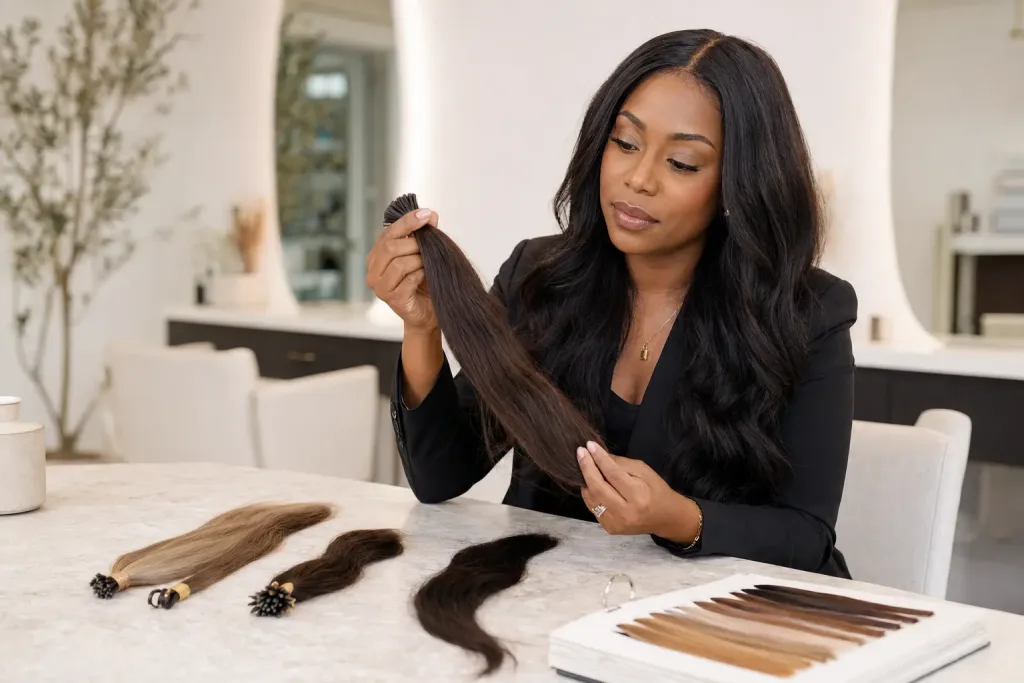
Buying bulk hair for keratin extensions is different from ordering a finished pack of pre-bonded strands. With bulk hair, the salon, extension specialist or manufacturing partner still has to divide the hair, control the weight of each strand and create a tip that works with the chosen application system. That extra flexibility can support custom color, texture and strand sizing, but it also creates more points to check before buying in volume.
The best sample is not simply the one that looks smooth when it arrives. It is the one that remains workable after your real preparation, bonding, washing, installation and removal tests. This guide explains how to compare bulk human hair for K-tip, I-tip and U-tip services without relying on grade names or catalog photos alone.
Menu
- Can bulk human hair be used to make keratin extensions?
- Bulk hair vs. pre-bonded extensions
- I-tip, U-tip and K-tip: confirm the system before ordering
- How to choose bulk hair for keratin extensions
- How to test a sample before a wholesale order
- A wholesale specification to send a supplier
- Should a salon buy bulk hair or ready-made keratin tips?
- Client safety and professional installation
- Common buying mistakes
- Frequently asked questions
- Request a sample for your extension service
- Sources
- About the author
- Related resources
- Explore wholesale hair categories
Can bulk human hair be used to make keratin extensions?
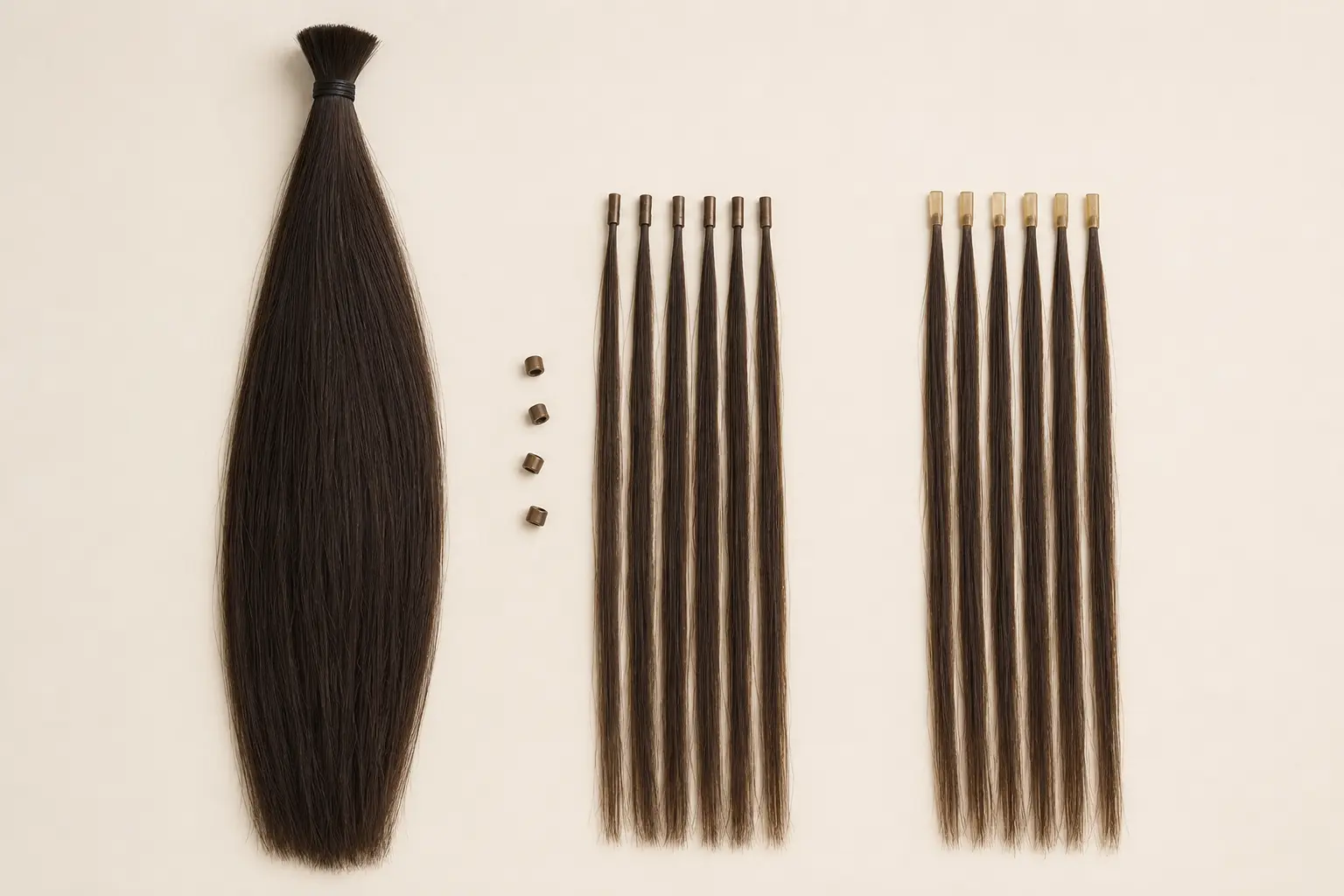
Yes. Loose, unwefted human hair can be divided into small sections and prepared as custom strand-by-strand extensions. Depending on the system, a trained professional or manufacturing partner may add a keratin or polymer tip, prepare an I-tip for bead application, or form a U-tip or K-tip bond for fusion installation.
However, “bulk human hair” only describes the loose format. It does not confirm that a particular batch will:
- separate cleanly into consistent sections;
- tolerate the chosen bonding process;
- match the client’s texture and color;
- stay balanced from the top to the ends;
- perform consistently after washing;
- produce uniform finished tips.
For that reason, the purchasing decision should start with the finished extension system and its service requirements, not with the bulk-hair label.
Bulk hair vs. pre-bonded extensions
Both formats can be suitable for a professional salon. The better option depends on how much customization and production work the business wants to manage.
| Buying format | What arrives | Main advantage | Main responsibility |
|---|---|---|---|
| Bulk human hair | Loose hair without a weft, tape, clip or finished tip | Maximum control over strand size, color mixes and finished bond format | The buyer must prepare or commission the tips and test the complete system |
| Pre-bonded I-tip hair | Individual strands with narrow tips, normally used with a compatible bead system | Faster preparation before installation | Confirm tip size, bead compatibility, strand weight and batch consistency |
| Pre-bonded U-tip or K-tip hair | Individual strands with heat-activated bonds shaped for a fusion method | Ready for a specified fusion workflow | Confirm bond material, shape, application tool and removal procedure |
Bulk hair may suit an extensionist who already makes custom tips, a salon that needs unusual color blends, or a private-label buyer developing a specific strand format. Pre-bonded hair may be more efficient when the salon wants consistent ready-made strands and does not have a controlled preparation process.
Do not compare the two choices by bundle price alone. Include preparation time, bonding materials, rejected strands, staff training, testing and the usable yield from the sample.
I-tip, U-tip and K-tip: confirm the system before ordering
Suppliers and salons do not always use extension terminology in exactly the same way. Ask for a clear photo, dimensions and installation description instead of assuming that a product name identifies the entire system.
I-tip extensions
An I-tip is typically a narrow pre-tipped strand installed with a small bead or ring. The application normally uses a clamping tool rather than melting the tip onto the natural hair. Because bead sizes, linings and tools vary, the finished I-tip must be tested with the exact hardware the salon uses.
U-tip extensions
A U-tip usually has a small U- or nail-shaped pre-bonded tip. A trained extensionist softens the bond with a compatible heat tool and forms it around an appropriate section of the client’s hair. Bond composition, tool settings and removal products are system-specific.
K-tip or keratin-bond extensions
“K-tip” commonly refers to an individual keratin-bond or fusion strand. Some suppliers use K-tip as a broad category, while others distinguish K-tip, U-tip, V-tip and flat-tip shapes. Request the exact finished shape and application method before approving a sample.
The key buying question is not which name sounds more premium. It is whether the hair, bond, strand weight, tool and salon technique have been tested together as one system.
How to choose bulk hair for keratin extensions
1. Define the finished service
Write a short service specification before contacting a supplier:
- I-tip, U-tip, K-tip or another strand format;
- desired finished length;
- straight, wavy or curly texture;
- natural color, processed color or custom blend;
- target strand size;
- expected number of strands per service;
- client hair type and density range;
- whether the salon will make tips in-house or use a production partner.
This prevents a common mismatch: buying attractive loose hair before confirming how it will be divided, bonded and installed.
2. Ask for the processing history
Terms such as raw, virgin, Remy and double drawn are used differently across the market. Treat them as starting points for questions, not as complete specifications.
Ask whether the sample has been colored, lightened, texture-processed or coated. If the finished service includes additional color or heat, test the exact sample first. Previous processing can affect the hair and may also change how the top of the strand behaves during tip preparation.
Avoid promising a color result based only on country of origin or a grade name. A controlled strand test gives the salon more useful evidence.
3. Check strand direction and separation
Custom tips require the hair to be separated into many small, repeatable sections. During the sample review, record:
- how easily the bundle separates;
- whether strands catch or reverse during handling;
- how much short hair or waste appears;
- whether the top remains organized;
- how long preparation takes;
- whether the same weight can be repeated across multiple sections.
Hair that feels pleasant as one bundle may become slow or wasteful when divided into dozens of small strands. Test the production step that your business will actually use.
4. Match texture to the client and service
Texture affects blending, styling time and maintenance. Compare the sample with the client’s natural pattern and the intended finished look under neutral lighting.
For wavy or curly hair, document the pattern before washing and again after the approved wash-and-dry process. For straight hair, check whether the mid-lengths and ends remain aligned without relying on heavy styling. If the salon plans to heat-style the finished extensions, use only settings and products appropriate for the tested hair and bond system.
5. Verify length and usable fullness
Ask how the supplier measures straight, wavy and curly hair. Then use the same method during sample inspection.
Also compare more than the longest strand. Examine:
- fullness through the mid-lengths;
- the shape and condition of the ends;
- the amount of shorter hair released during sectioning;
- usable weight after preparation;
- consistency between several sample sections.
The best specification is one your purchasing and technical teams can measure again when the production order arrives.
6. Test color under repeatable conditions
Screen images and color numbers can vary. Review samples in daylight or under a consistent salon light, then compare the root area, mid-lengths and ends.
If the finished service uses a custom blend, record the proportion of each sample color and photograph the result against the client’s hair. If the hair will be colored before or after tip preparation, test that sequence rather than assuming the order of operations makes no difference.
7. Calculate yield, not only package weight
The salon pays for the total bundle but sells or installs usable finished strands. Record:
- starting sample weight;
- preparation waste;
- number of accepted finished tips;
- rejected or reworked tips;
- average preparation time;
- remaining loose hair.
This gives a more realistic comparison between suppliers and between bulk and pre-bonded options. There is no universal finished-strand count for every client; strand size and total weight must be selected by a trained professional for the individual service.
How to test a sample before a wholesale order
Step 1: Record the sample as received
Photograph the hair in neutral light and record the supplier, sample code, stated texture, color, length, weight and processing information. Keep this record with the finished test strands.
Step 2: Wash and dry a controlled section
Follow the supplier’s care directions and keep the products, water temperature and drying method consistent. Note changes in texture, tangling, feel, color and the condition of the ends.
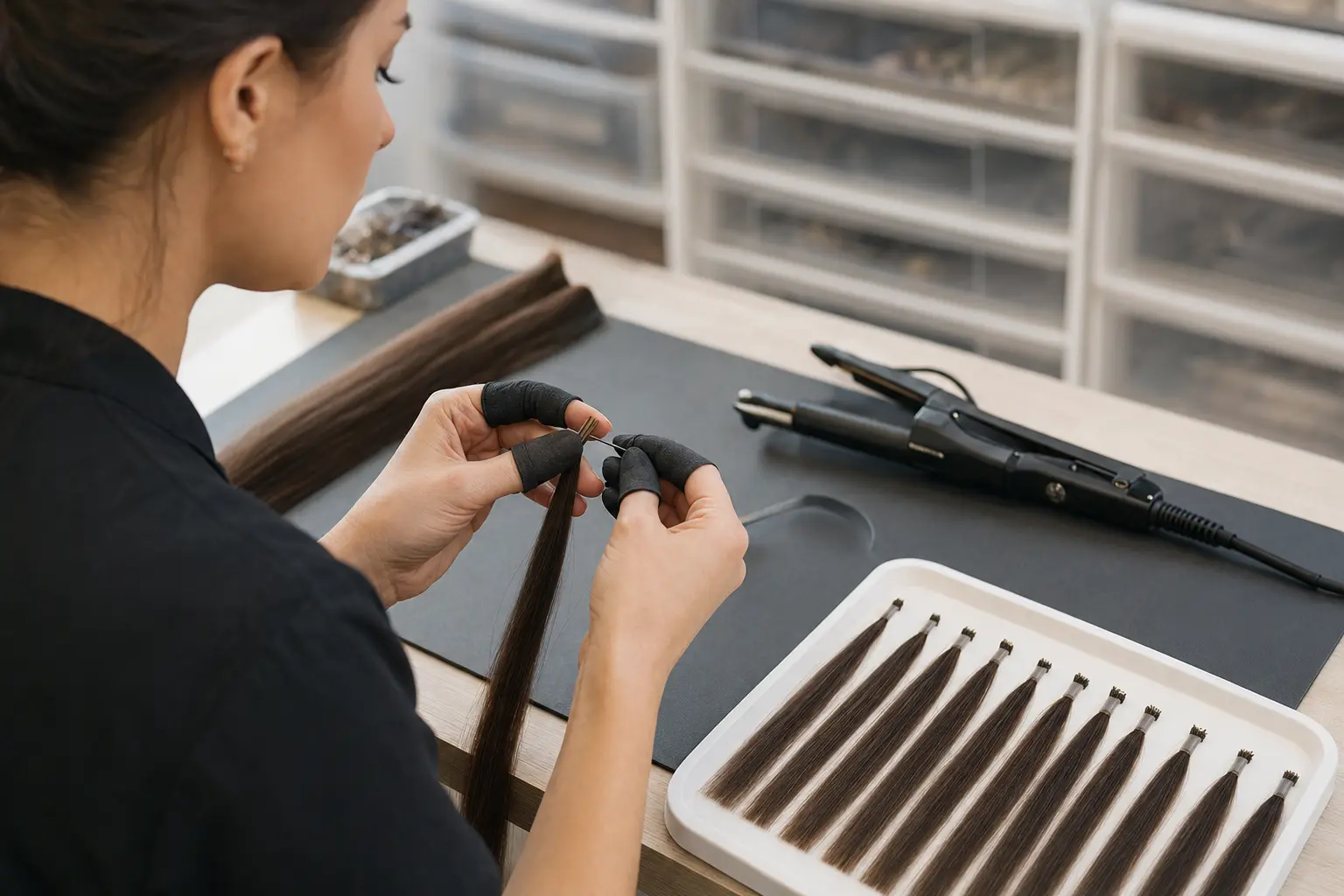
Step 3: Prepare a small production batch
Have the trained person who will make the tips divide and prepare a limited number of strands. Use the intended bond material, tool and workflow. Do not improvise heat settings or chemical products; follow the instructions for the professional system being tested.
Step 4: Inspect the finished tips
Check whether the tips are uniform in:
- strand weight;
- bond size and shape;
- hair distribution inside the bond;
- flexibility;
- color;
- surface finish.
A few attractive strands are not enough. Repeat the process and look for consistency across the test batch.
Step 5: Perform a controlled strength check
Use the salon’s documented quality-control method to check whether the hair and bond stay connected during normal handling. An improvised aggressive pull can damage any sample and does not represent client use. Record the same method for every supplier.
Step 6: Test the complete service
The responsible extension professional should test application, movement, washing, maintenance and removal using the compatible system. A mannequin or controlled salon trial can reveal issues that are invisible at the buying table, including bulky bonds, difficult sectioning, slippage or excessive preparation time.
Step 7: Compare with the approved sample
When the main order arrives, compare it with the retained sample before distributing it or preparing the full batch. Photograph differences and record the batch information immediately.
A wholesale specification to send a supplier
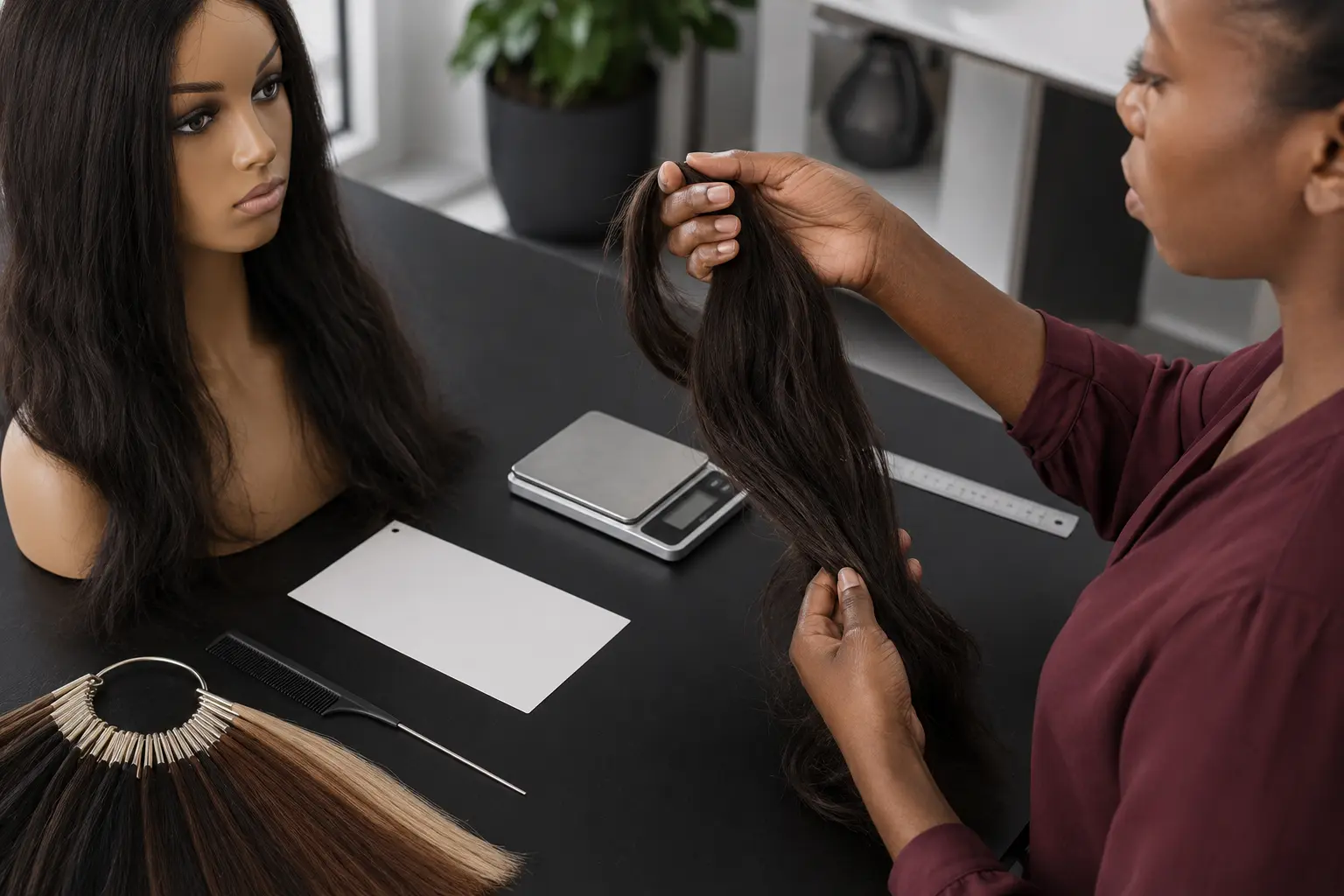
The clearer the enquiry, the easier it is to compare suitable options.
| Specification | Information to provide or confirm |
|---|---|
| Product format | Loose, unwefted bulk human hair |
| Intended use | Custom I-tip, U-tip, K-tip or other strand system |
| Texture | Straight, wavy, curly or a physical reference sample |
| Color | Supplier code plus daylight photo or physical color reference |
| Length | Required length and measurement method |
| Fullness | Requested drawn specification and expected shape through the ends |
| Processing | Known color, texture or coating history |
| Sample | Whether it represents the same specification as a future order |
| Quantity | Test quantity first, then estimated production requirement |
| Business needs | Destination, packaging or private-label requirements, if applicable |
Ask the supplier to confirm current availability, price, sample terms, production requirements, delivery options and applicable policies in writing. These details can change and should not be copied from an old catalog or assumed from another buyer’s order.
Anvi Hair’s bulk hair collection shows available product examples, while the keratin and flat-tip extension page provides a reference for finished strand formats. Confirm the exact current specification directly before ordering.
Should a salon buy bulk hair or ready-made keratin tips?
Choose bulk hair when:
- the business needs custom strand sizes or color blends;
- a trained team already has a repeatable tip-making process;
- the buyer wants to control the loose-hair specification;
- production time, materials and rejection rates have been measured;
- a representative sample has passed the complete test workflow.
Choose pre-bonded hair when:
- faster preparation is more important than custom production;
- the salon uses a clearly defined compatible system;
- finished tip size and strand weight are consistent;
- the supplier’s sample performs well in installation and removal tests;
- the business does not want to manage bonding production.
Some businesses use both: pre-bonded strands for standard services and bulk hair for special blends or custom sizes. Keep the product codes and test records separate so staff know which workflow applies.
Client safety and professional installation
Hair quality is only one part of a safe extension service. The weight of the added hair, the size of the natural-hair section, bond placement, tension, maintenance and removal technique all matter.
The American Academy of Dermatology advises that extensions should be installed by a professional and should not feel painful or cause a headache. Repeated pulling can contribute to traction alopecia and, if it continues, hair loss may become permanent.
Before installation:
- assess the client’s hair and scalp;
- select a suitable strand weight and section size;
- avoid painful tension;
- follow the chosen system’s training and instructions;
- explain maintenance and removal;
- stop and refer the client to a qualified health professional if there are concerns about scalp health or hair loss.
Bulk hair should never be treated as permission to make strands heavier than the client’s natural hair can safely support.
Common buying mistakes
Buying by grade name alone
A grade name does not show preparation yield, bond compatibility or finished-strand consistency. Compare measurable specifications and test results.
Testing the hair but not the bond
The hair, bonding material, strand weight and application method work together. A sample has not passed until the complete system has been evaluated.
Using one catalog photo to approve color
Request a physical sample or repeatable visual reference when color matching is important.
Ignoring preparation labor
Custom tips can provide flexibility, but staff time and rejected strands affect the real cost. Record them.
Scaling before retaining an approved sample
Keep a labeled control sample and the test record. Use both when inspecting the next shipment.
Frequently asked questions
Is I-tip hair the same as K-tip hair?
Usually not. I-tip strands are commonly applied with a bead or ring and do not require melting the tip during installation. K-tip or fusion strands normally use a heat-activated bond. Terminology varies, so confirm the exact tip, tool and application method.
Can any bulk human hair be made into K-tips?
Loose human hair can be prepared into custom tips, but not every sample will perform equally. Test sectioning, processing history, usable fullness, bond compatibility and the finished service before ordering in volume.
Is bulk hair cheaper than pre-bonded extensions?
The package price may be lower, but the real comparison must include labor, bonding material, waste, rejected tips, training and quality control. Calculate cost per accepted finished strand.
Should hair be colored before or after making the tips?
That decision depends on the hair, color process and bond system. Test the intended sequence on a small sample and follow professional product instructions. Do not promise a result before testing.
How much hair is needed for a full K-tip or I-tip service?
There is no universal amount. The client’s density, desired length and fullness, strand weight, placement and professional assessment all affect the total.
What should a wholesale buyer test first?
Begin with the hair’s processing information, separation, texture, color, length and usable fullness. Then prepare a small batch of finished tips and test the complete application and removal workflow.
Request a sample for your extension service
Explore Anvi Hair’s bulk human hair options and read the broader Vietnamese hair extensions wholesale guide. Then contact Anvi Hair with your intended tip system, texture, color, length, test quantity, destination and any packaging requirements.
Sources
- Anvi Hair — Bulk Hair collection
- Anvi Hair — Keratin and Flat Tip hair extensions
- Anvi Hair — Vietnamese Hair Extensions Wholesale Buyer Guide
- American Academy of Dermatology — How to prevent hair damage from a weave or extensions
- Great Lengths — Pre-bonded hair extensions

Explore wholesale hair categories
