
Hair Knowledge
Raw Vietnamese Hair vs Virgin Hair: Buyer’s Guide
Jul
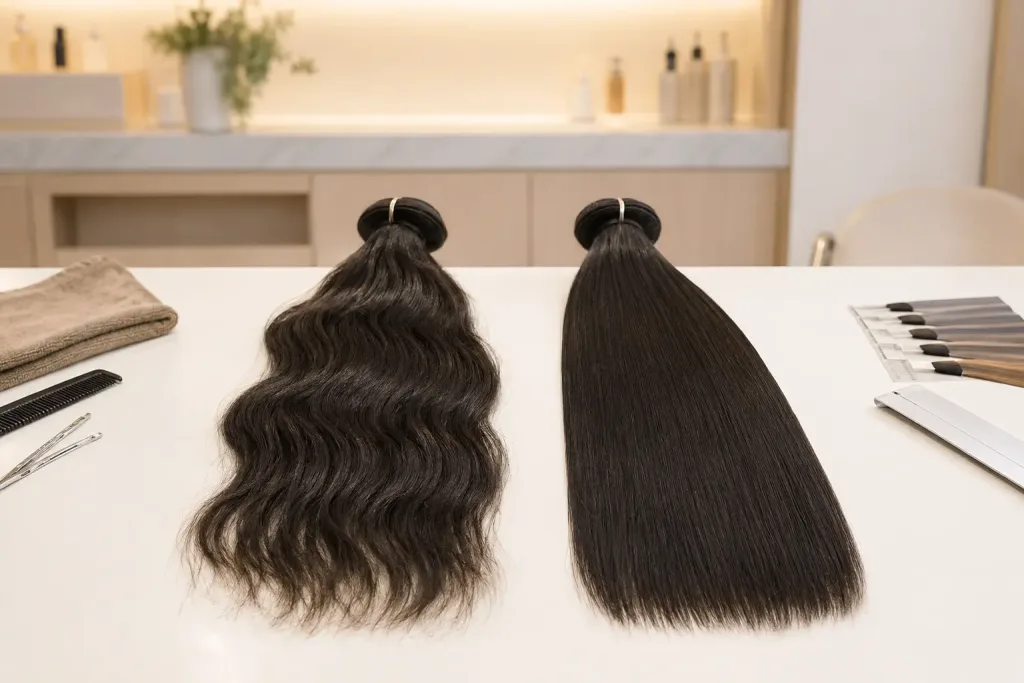
When a supplier offers both raw and virgin Vietnamese hair, the price list can make the distinction look simple. For a salon or wholesale buyer, however, the useful questions are: What happened to this batch, what evidence can the supplier provide, and how does the sample perform under a controlled test?
This guide compares raw Vietnamese hair vs virgin hair from a B2B buyer’s perspective. It focuses on processing history, strand direction, cuticle condition, wash performance and sample approval—not on grade names alone.
Menu
- Raw Vietnamese hair vs virgin hair: the quick answer
- What “raw Vietnamese hair” should mean in a purchase specification
- What “virgin hair” should mean to a wholesale buyer
- Raw, virgin, Remy and single donor are different claims
- Why cuticle condition matters—and what it cannot prove
- Processing history matters more than softness on arrival
- A controlled pre- and post-wash test for wholesale samples
- Buyer checklist: evidence to request before ordering
- Which should your salon or hair business buy?
- Questions to send a Vietnamese hair supplier
- Frequently asked questions
- Request a representative sample
- Sources
- About the author
- Related resources
- Explore wholesale hair categories
Raw Vietnamese hair vs virgin hair: the quick answer
In common wholesale usage, raw Vietnamese hair refers to hair sold close to its collected state, without chemical coloring, bleaching, permanent texture alteration or acid processing. Virgin hair is also marketed as uncolored and unbleached, but some suppliers use the term for a wider range of preparation or texture-standardization practices.
These are working market definitions, not a complete purchase specification. Request written batch details and test a representative sample before approving volume.
| Buyer question | Raw Vietnamese hair | Virgin hair |
|---|---|---|
| Typical market position | Natural, minimally altered premium material | Natural-looking human hair offered in a wider range of standardized products |
| Color and texture | Often retains natural variation | May be selected or prepared for greater visual consistency |
| What the label proves | Nothing by itself; request records and test the sample | Nothing by itself; request records and test the sample |
| Main buying advantage | Natural characteristics and flexibility when the batch is genuinely minimally processed | Easier repeat ordering when the supplier controls a consistent specification |
| Main buying risk | Paying a premium for an unsupported claim | Assuming “virgin” means the same processing standard across suppliers |
| Best approval method | Written processing declaration plus retained sample and repeatable QC | Written processing declaration plus retained sample and repeatable QC |
What “raw Vietnamese hair” should mean in a purchase specification
Instead of accepting one line that says “100% raw,” ask whether the hair has been:
- permanently colored or lightened;
- chemically straightened, curled or relaxed;
- acid-treated or subjected to cuticle-removal processing;
- coated to create temporary slip or shine;
- steam-shaped or heat-set into a uniform texture;
- blended from different collection lots;
- drawn or sorted to change the distribution of strand lengths.
Sorting and wefting do not automatically make hair chemically processed, while a natural wave does not prove that a bundle is raw. Establish a traceable history for the SKU and batch. “Vietnamese” identifies claimed origin; it does not replace measurable specifications for color, texture, length, fullness, weight and processing.
What “virgin hair” should mean to a wholesale buyer
Virgin hair is often described as hair that has not been dyed, bleached, permed or chemically relaxed. In practice, buyers may encounter virgin-labeled products with different levels of sorting, washing, texture preparation or coating.
That does not automatically make every virgin product unsuitable. A controlled, well-documented product can be valuable for a salon that needs repeatable colors, textures and price points. The risk appears when the label replaces the specification.
For each virgin-hair SKU, confirm:
- the original and current color;
- whether the texture is natural or created;
- any chemical, steam or heat process used;
- whether a coating or finishing product is applied;
- whether the hair is kept in consistent strand direction;
- the donor or lot claim;
- whether the sample represents the production order.
If some historical detail is unavailable, record what is known and let test results guide a limited purchase. Do not turn uncertainty into a customer promise.
Raw, virgin, Remy and single donor are different claims
These terms answer different questions and should not be treated as interchangeable.
- Raw is a claim about how little the hair has been altered.
- Virgin is usually a claim about the absence of major chemical color or texture treatment.
- Remy relates to maintaining a consistent root-to-tip strand direction.
- Single donor is a sourcing claim about the hair in a bundle or lot.
- Single drawn, double drawn and super double drawn describe the distribution of strand lengths and fullness, not chemical history.
A bundle could be described as Remy without being raw. A raw-labeled lot could still contain natural variation in color and strand diameter. A double-drawn bundle has been sorted for fullness, but the drawn level does not tell you whether it was colored.
For B2B purchasing, put each claim in its own field. This makes supplier quotations easier to compare and reduces misunderstandings when an order is repeated.
Why cuticle condition matters—and what it cannot prove
The cuticle is the outer protective structure of a hair fiber. Research on human hair shows that cuticle properties contribute to surface behavior such as friction and shine. Studies of bleached fibers also document structural disruption to the cuticle and cortex.
This supports a practical buying principle: previous processing can affect how hair behaves. It does not mean a buyer can prove that a bundle is raw by touching it once or looking at a phone photo.
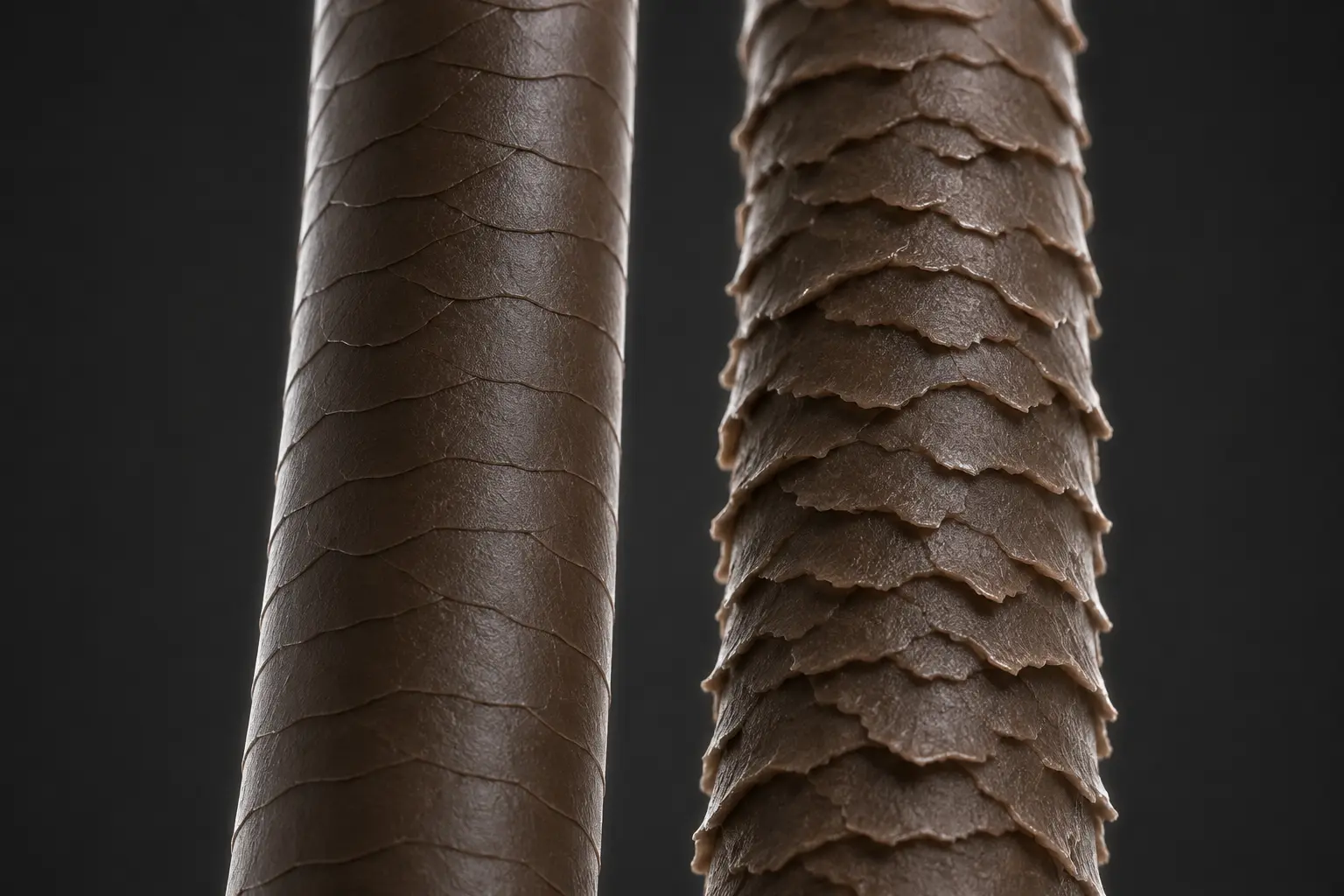
During a sample inspection, check for:
- unusually slippery feel that changes quickly after washing;
- roughness or catching when fingers move gently from ends toward the top;
- excessive short fibers released during handling;
- tangling that increases after the first controlled wash;
- visible differences between the top, middle and ends.
These are observations, not laboratory certification. Use them to decide whether further testing is needed. If cuticle condition is central to a large contract, discuss an independent microscopy or fiber-testing option with a qualified laboratory.
Processing history matters more than softness on arrival
Softness can come from healthy, well-aligned hair, but it can also come from conditioning or surface finishing. A sample that feels luxurious inside the package may behave differently after its first wash.
Published hair-fiber research shows that bleaching can alter the cuticle and internal structure, with damage increasing under more intensive conditions. This does not predict every extension bundle, but it explains why undocumented processing creates commercial risk.
A successful bleach strand is not proof of origin or future-batch performance. Treat it as a compatibility test for one sample, record the result and repeat the check when production arrives.
A controlled pre- and post-wash test for wholesale samples
A repeatable sample test is more useful than an aggressive viral “hair test.” The goal is to compare samples under the same conditions, not to destroy them.
1. Register the sample
Assign a sample ID and record:
- supplier and contact;
- date received;
- quoted product name;
- claimed origin and processing history;
- natural or processed texture;
- color, length, drawn level and weight;
- donor or lot claim;
- intended product format and market.
Photograph the sealed sample and original tags before opening it.
2. Inspect it dry
Use neutral lighting. Weigh and measure the sample with your documented method, examining the top, mid-lengths and ends. Detangle gently for a fixed number of passes, collect released fibers and note residue, static, color transfer and separation.
3. Wash a controlled section
Keep an untouched control. Wash a measured section with the same water source, temperature range, product quantity and technique used for every comparison sample.
Record:
- wet tangling and detangling effort;
- residue or unusual runoff;
- color movement;
- strand loss;
- texture change;
- drying time and drying method.
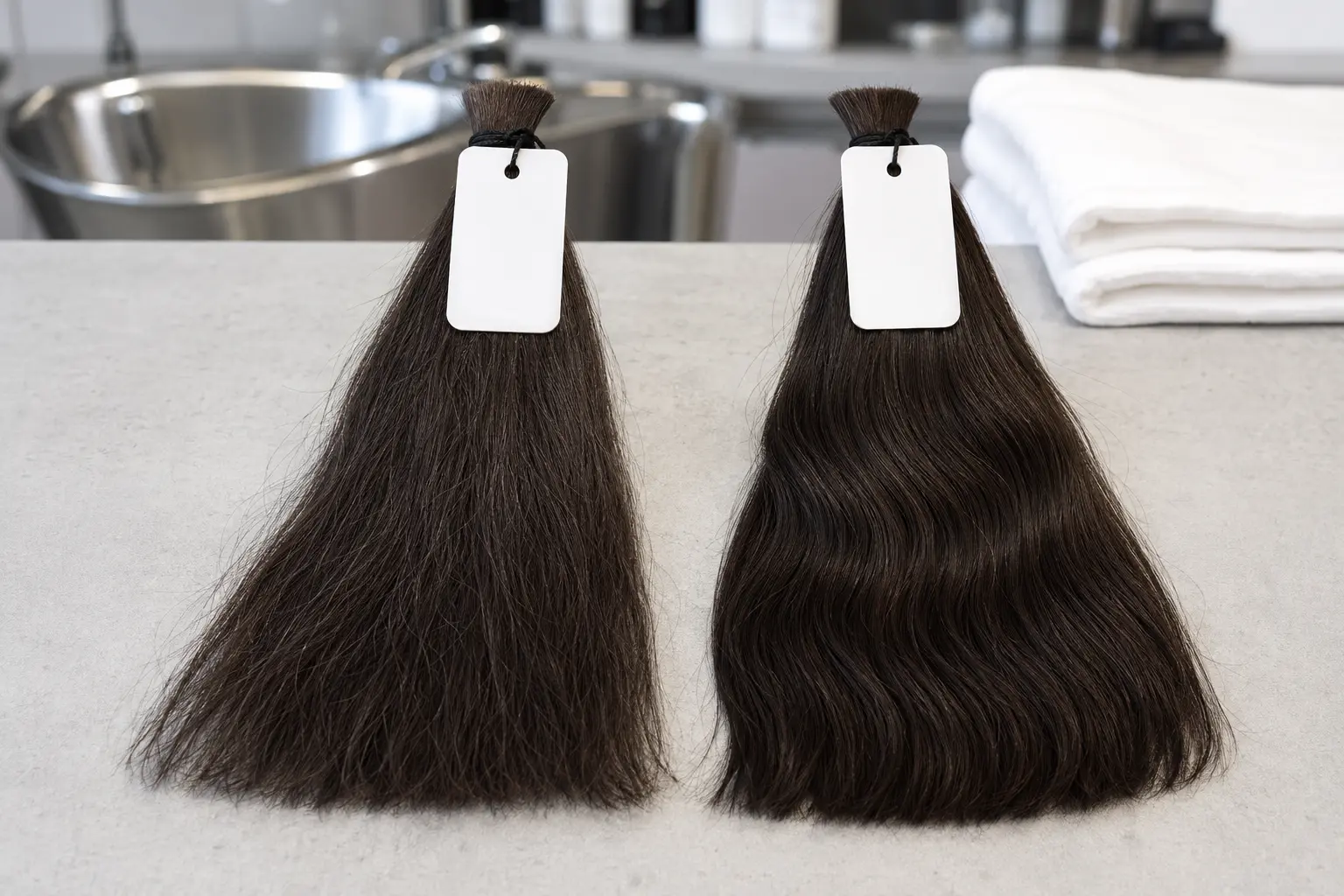
4. Inspect it after complete drying
Compare the washed section with the control. Look for changes in slip, shine, texture, fullness, odor, frizz and end condition. Repeat the same gentle combing sequence and record the released fibers.
Natural texture may become more visible after washing; the question is whether the result matches the supplier’s declaration and your specification.
5. Run only relevant compatibility tests
If your business intends to color, heat-style, ventilate, weft or tip the hair, test a small section using the exact professional workflow planned for that SKU. Do not improvise chemical ratios or tool settings.
Record the result and usable yield. A sample that survives a process but creates excessive waste or labor may still be a poor wholesale choice.
6. Retain the approved control
Seal and label an unaltered portion and a tested portion of the approved sample. Keep the photos and worksheet with them. When the main order arrives, compare random units against this control before distribution or client installation.
Buyer checklist: evidence to request before ordering
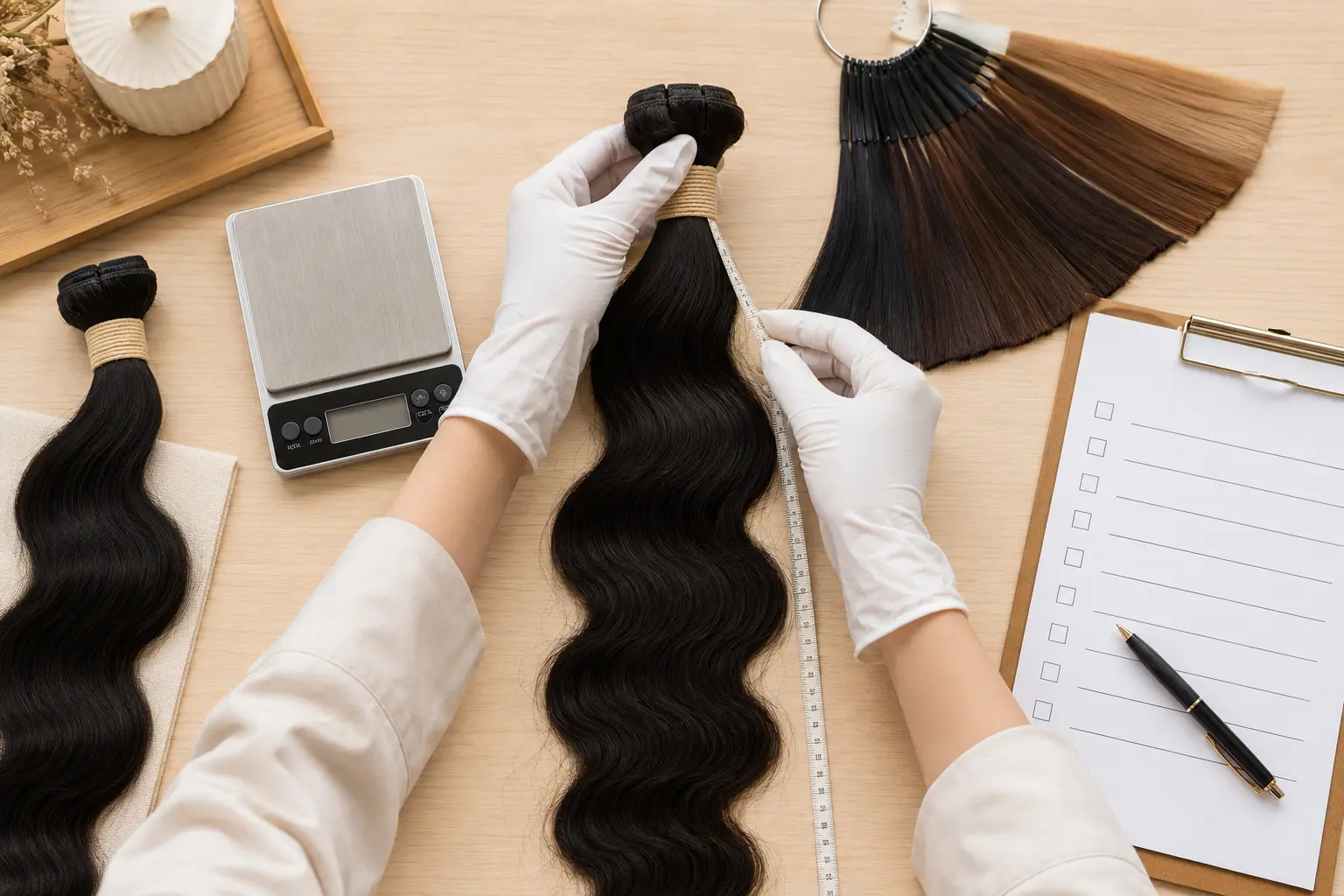
| Evidence or specification | Why it matters | How to verify |
|---|---|---|
| Written processing declaration | Separates a marketing label from a batch claim | Ask the supplier to confirm color, texture, acid, coating, steam and heat history |
| Representative sample | Gives the buyer a physical approval standard | Confirm that production will match the sample specification |
| Root-to-tip direction claim | Helps assess tangling risk and consistency | Inspect strand organization and compare pre/post-wash handling |
| Origin and lot information | Supports traceability | Record supplier documents and batch identifiers |
| Length and fullness method | Prevents disputes about bundle shape | Measure with the same documented method |
| Weight tolerance | Protects usable inventory | Weigh several units, not only one sample |
| Color and texture tolerance | Defines acceptable natural variation | Approve reference photos and a retained physical sample |
| Corrective-action terms | Clarifies what happens if production differs | Put inspection period and resolution process in writing |
For broader questions about supplier evaluation, ordering and wholesale product formats, use Anvi Hair’s Vietnamese hair extensions wholesale buyer guide. Keep this raw-versus-virgin comparison as the technical approval layer within that larger buying process.
Which should your salon or hair business buy?
Choose a raw-hair specification when:
- natural color and texture variation support your premium positioning;
- the processing declaration is clear;
- the sample passes your intended coloring or production workflow;
- you can manage natural variation through batch-based inventory.
Choose a virgin-hair specification when:
- consistent repeatable SKUs are more important than the “raw” label;
- the preparation history is disclosed;
- the sample performs reliably after washing and styling;
- the price, usable yield and accurate product description fit your market.
The better product is the one that matches the service and passes the agreed specification. Raw should not be an automatic purchase, and virgin should not be dismissed automatically. Evidence, sample performance and batch consistency should decide.
Buyers developing loose-hair products can review Anvi Hair’s bulk hair collection. Businesses selling sewn bundles can compare formats in the weave hair collection. Current availability and exact processing details should always be confirmed directly.
Questions to send a Vietnamese hair supplier
Attach these questions to the quotation:
- How do you define raw hair and virgin hair for this SKU?
- What chemical, color, texture, steam, heat, acid or coating processes have been used?
- Is the texture natural, prepared or standardized?
- Is the hair kept in consistent root-to-tip direction?
- What donor or collection-lot claim applies?
- How are length, weight and drawn level measured?
- Will the approved sample represent and be referenced by the production order?
- What is the written resolution process if the order differs from the approved specification?
The answers do not need to sound impressive. They need to be specific enough for both parties to verify.
Frequently asked questions
Is raw Vietnamese hair always better than virgin hair?
No. Raw hair may be the better fit when minimal alteration and natural characteristics are important, but only if the claim is supported and the batch passes testing. A consistent virgin-hair product can be more suitable for a standardized salon or retail range.
Does raw hair always come from one donor?
Do not assume so. Raw and single donor are separate claims. Ask the supplier to state the donor or lot structure in writing.
Can I identify raw hair by touch?
Touch can reveal slip, roughness or residue, but it cannot prove origin or complete processing history. Combine physical inspection with supplier documentation and controlled testing.
Does a successful bleach test prove hair is raw?
No. It only shows how that sample responded to that particular test. It does not prove origin, donor structure or the history of every future batch.
Is Remy hair the same as virgin hair?
No. Remy describes consistent strand direction, while virgin is generally used for processing history. A product may be described with both terms, one term or neither.
What should a first-time wholesale buyer order?
Start with a representative sample of the exact SKU and test it against a written specification. Approve a limited order only after the sample passes your real wash, styling and production workflow.
Request a representative sample
To compare raw Vietnamese hair and virgin hair for your market, contact Anvi Hair with the product format, texture, color, length, drawn level, test quantity, destination and any planned color or production process.
Ask the team to identify the sample and confirm its processing declaration in writing. Your approved sample can then become the reference for a future wholesale order.
Sources
- Anvi Hair, Vietnamese Hair Extensions Wholesale: The Ultimate Buyer Guide
- Fellows et al., Nanoscale Molecular Characterization of Hair Cuticle Cells
- Grosvenor et al., The physical and chemical disruption of human hair after bleaching
- Kim et al., Effects of excessive bleaching on hair
- Leerunyakul and Suchonwanit, Asian Hair: A Review of Structures, Properties, and Distinctive Disorders

Explore wholesale hair categories
